
 Quick search
| Astringent formulas | Blood-regulating formulas | Dampclearing formulas
| Digestive formulas | Dryness-moistening formulas | Emetic formulas
| Exterior-releasing formulas | Harmonizing formulas | Heat-clearing formulas
| Phlegm-expelling formulas | Purgative formulas | Qi-regulating formulas
| Resuscitative formulas | Sedative and tranquilizing formulas
| Summer-heat clearing formulas | Tonic formulas | Vermifuge formulas
| Warming interior formulas | Wind-calming formulas
| Digestive formulas | Dryness-moistening formulas | Emetic formulas
| Exterior-releasing formulas | Harmonizing formulas | Heat-clearing formulas
| Phlegm-expelling formulas | Purgative formulas | Qi-regulating formulas
| Resuscitative formulas | Sedative and tranquilizing formulas
| Summer-heat clearing formulas | Tonic formulas | Vermifuge formulas
| Warming interior formulas | Wind-calming formulas
Quick search: 


| No. | Name | Combination | Action | Indication | Thumbnail | |||||
|---|---|---|---|---|---|---|---|---|---|---|
| 1 | Major Wind-Stabilizing Pill |
Paeoniae Radix Alba; Asini Corii Colla; Testudinis Plastrum; Rehmanniae Radix; Cannabis Fructus; Schisandrae Chinensis Fructus; Ostreae Concha; Ophiopogonis Radix; Glycyrrhizae Radix et Rhizoma Praeparata cum Melle; Egg Yolk; Trionycis Carapax |
Enriches yin and extinguishes wind. |
Da Ding Feng Zhu is indicated for a pattern of stirring of wind due to yin deficiency. The symptoms are clonic convulsions of the extremities, weak physique, lassitude of the spirit, a deep red tongue body with a scanty tongue coating, and a weak pulse; patients have a strong tendency of desertion. |

|
|||||
| 2 | Large Gentian Decoction |
Gentianae Macrophyllae Radix; Glycyrrhizae Radix et Rhizoma; Chuanxiong Rhizoma; Angelicae Sinensis Radix; Paeoniae Radix Alba; Asari Radix et Rhizoma; Notopterygii Rhizoma et Radix; Saposhnikoviae Radix; Scutellariae Radix; Gypsum Fibrosum; Angelicae Dahuricae Radix; Atractylodis Macrocephalae Rhizoma; Rehmanniae Radix; Rehmanniae Radix Praeparata; Poria; Angelicae Pubescentis Radix |
Scatters wind and clears heat, nourishes and invigorates blood. |
Da Qin Jiao Tang is indicated for an early stage of a wind attacking the channels and collaterals pattern. The symptoms are deviation of the eyes and mouth, difficulty in speaking due to stiff tongue, an inability to move the extremities, often accompanied by aversion to cold with fever, spasms and tension of the extremities, a white or yellow tongue coating, and a superficial, rapid pulse or wiry, thin pulse. |

|
|||||
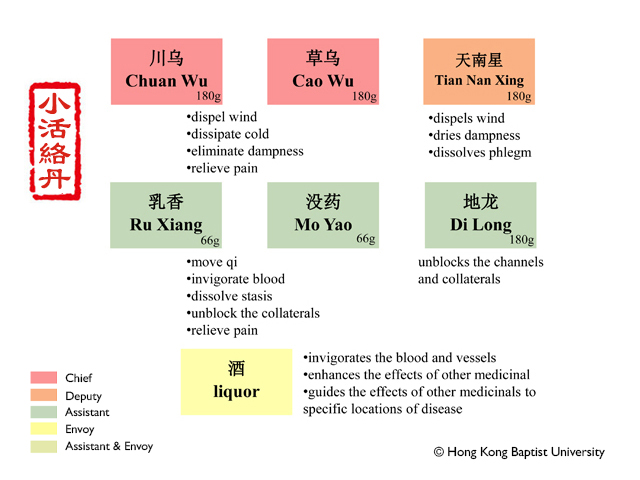
| 3 | Minor Channel-Activating Elixir | Aconiti Radix Cocta; Aconiti Kusnezoffii Radix Cocta; Pheretima; Arisaematis Rhizoma Preparatum; Olibanum; Myrrha | Dispels wind and eliminates dampness, dissolves phlegm to unblock the collaterals, and invigorates blood to relieve pain. |
1. Bi syndrome due to wind, cold, and dampness characterized by pain, numbness, and spasms of the limbs, body and sinews, dysfunction with bending and stretching the joints, wandering pain, a pale purple tongue body with a white tongue coating, and a deep, wiry or choppy pulse. 2. Wind-strike due to dampness, phlegm, and blood stasis obstructing the collaterals characterized by persistent numbness and weakness of the limbs, heavy sensation in the waist and legs, or pains in the legs and arms, etc. |
|
|||||
| 4 | Tea-Mix and Chuanxiong Powder |
Chuanxiong Rhizoma; Schizonepetae Herba; Angelicae Dahuricae Radix; Notopterygii Rhizoma et Radix; Glycyrrhizae Radix et Rhizoma; Asari Radix et Rhizoma; Saposhnikoviae Radix; Menthae Haplocalycis Herba |
Scatters wind and relieves pain. |
Chuan Xiong Cha Tiao San is indicated for headaches caused by externally-contracted wind. The symptoms are headache in any part of the head, dizzy vision, and nasal congestion possibly accompanied by aversion to wind and fever. The tongue coating is thin and white, and the pulse is floating. |

|
