|
|
|
Rheum officinale Baill.
|
English Name |
Drug Rhubarb, Medicinal Rhubarb |
|
Latin name |
Rheum officinale Baill. |
|
Family & Genus |
Polygonaceae, Rheum |
|
Description |
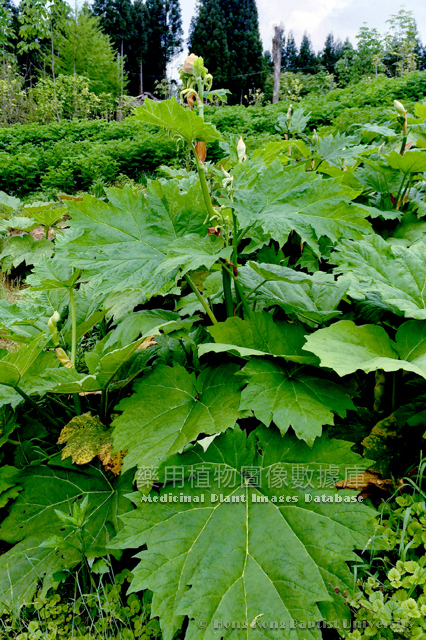
Perennial tall herbs, 1.5-2m tall. Stems sturdy hollow, with sparse white undercoat, more dense at the top and joints. Basal leaves with long petiole, leaves nearly orbicular with diameter 30-50cm, leaf blades 5, lobed, lobes largely dentate or broadly-deltoid; apex acute, base cordate, main vein usually 5-7, basal, glabrous on the top, sparse protrusions near veins, bottom with light brown short hair near veins and leaf margins; stem-leaves smaller, petioles short, and sheath tubular, membranous, transparent, short-haired, split to base. Large panicle, branches expanded, clusters of 4-10 flowers, alternate; buds oblong; perianth 6, light yellow-green, arranged in two layers, size of two layers similar, oblong, 2-2.5mm, edge not very neat; stamens 9, not exposed; ovary triangular, styles 3. Achenes, fruiting branches expanded, fruits oblong-elliptic and winged, 8-10mm long, 7-9mm wide, samara edges not transparent. Flowering: May to June. Fruiting: August to September. |
|
Distribution |
Growing in mountains, forest edges or grasslands. Distributed in Shaanxi, Henan, Hubei, Sichuan, Yunnan, Guizhou and other provinces. The medicinal materials are mainly produced in Sichuan, Hubei and other provinces. |
|
Part Used |
Medical parts: dried roots and rhizomes. Chinese Name: Dahuang. |
|
Harvest & Processing |
Excavated in late autumn when stems and leaves blighted or the next spring when germinated before excavation. Removed fine roots, scraped the skin, cut into segments or pieces, stringed up and indirectly or directly dried. |
|
Chemistry |
Contains free and combined anthraquinone derivatives. |
|
Pharmacology |
Catharsis, bile-draining, anti-hepatic fibrosis, anti-gastric-duodenal ulcers, anti-bacterial, anti-fungal, anti-viral, anti-inflammatory, hemostatic, hypolipidemic, and anti-tumor. |
|
Properties & Actions |
Bitter, cold.Expelling fever, relaxing the bowels, cooling the blood and detoxifying and expelling stasis to unblock the meridian. |
|
Indications & Usage |
Used for constipation induced by sthenic fever, abdominalgia due to dyspeptic disease, lingering dysentery, jaundice with damp-heat pathogen, vomiting and apostaxis due to heat in blood, conjunctival congestion, pharyngeal swelling, abdominalgia with intestinal abscess, anthracia and furunculosis, amenorrhea due to stagnation of blood, injuries from falls, externally applied to treat burns caused by hot liquids or fires, upper gastrointestinal bleeding.Oral administration: 3-30g, decocting; for purgation not decocted for long. External application: appropriate amount, powdered for applying or decocted for washing or external spread. Use with caution in cases of pregnancies. |
|
Examples |
1. Excess syndrome of yangmingfu-organ, unsmooth stool, gastric fullness: rhubarb 12g, officinal magnolia 24g, immature orange fruit 12g, natrii sulfas 6g. Decoct in water and swallow.
2. Abdominal pain due to cold accumulation: rhubarb, prepared aconite root 9g, each, wild ginger 3g. Decoct in water and swallow.
3. Onset of acute appendicitis: rhubarb, peach seed 12g each, suffruticosa peony 9g, melon seeds 30g, natrii sulfas 9g. Decoct in water and swallow. |
| Link to |
 Chinese Medicinal Material Images Database
Chinese Medicine Specimen Database Chinese Medicinal Material Images Database
Chinese Medicine Specimen Database
|
|
Permanent URL:https://sys01.lib.hkbu.edu.hk/cmed/mpid/detail.php?herb_id=D00003 |
|
|
|


