|
|
|
Ephedra sinica Stapf
|
English Name |
Chinese Ephedra, China Ephedra, Chinese Joint Fir |
|
Latin name |
Ephedra sinica Stapf |
|
Family & Genus |
Ephedraceae, Ephedra |
|
Description |
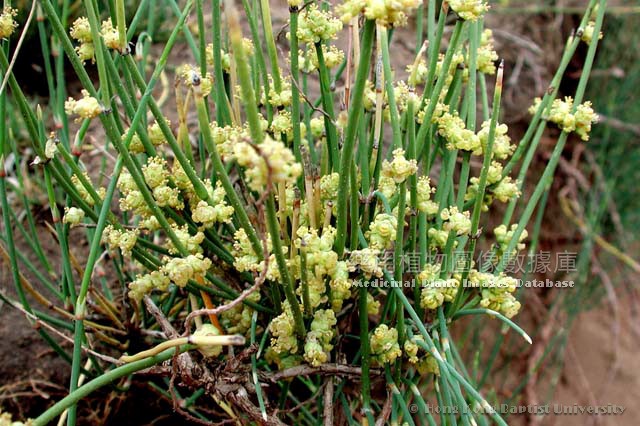
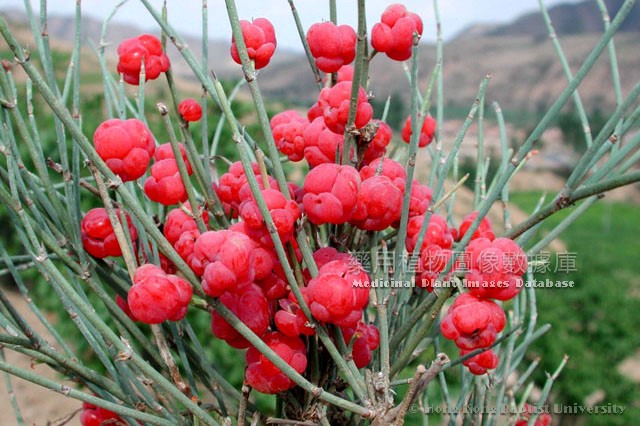
Herb-like perennial shrubs, 20-40cm tall. Woody stems short, often like roots, creeping on soil; herbaceous stems erect or slightly curved, yellow-green, long cylindrical, nodes prominent, internode length 2.5-5.5cm, diameter 1-2mm. Scale-like leaves membranous, sheath-like, 3-4mm long, the lower about 1/2 connate, around the internodes, the upper two lobed, lobes acutely triangular, with 2 veins in the middle, apex acute, often inflects outward. Inflorescence cone-like, usually dioecious, seldomly solitary; male cones often complex with multiple spikes, often with main peduncle, bracts 3-5 pairs, leathery, edge membranous, each bract with 1 male within; stamens 6-8, anthers combine together into a cluster, filaments connate into a bundle; female cones solitary, with stems, bracts 4-5 pairs, green, leathery, edge membranous, each bract with 1 female within; bracts expand when mature, fleshy, red, berry-like. Seeds 2, including in the bracts, non-exposed, dark red or brown, ovate, 4.5-6mm, about 4mm in diameter, surface covered with fine wrinkles. Flowering: May to June. Seeds: from July to August. |
|
Distribution |
Growing on arid deserts, ridges of much sand and rocks, hilltops or grasslands, often clustered. Can be cultivated. Distributed in North China and Jilin, Liaoning, Shaanxi, Xinjiang, Henan and other provinces. The medicinal materials are mainly produced in Hebei, Shanxi, Xinjiang, Inner Mongolia and other provinces. |
|
Part Used |
Medical parts: herbaceous stems, rhizomes. Chinese Name: Mahuang (herbaceous stems); Mahuanggen (rhizomes). |
|
Harvest & Processing |
Herbaceous stems: cut in autumn when green. Roots and rhizomes: dried after residual stems, fibrous roots and sands removed. |
|
Chemistry |
Contains l-ephedrine, d-pseudo-ephedrine) and volatile oil. |
|
Pharmacology |
Pant-calming, cough-suppressing, phlegm-dispelling, sudorific, diuretic, anti-inflammatory, antipyretic, and CNS-exciting. |
|
Properties & Actions |
Herbaceous stems: Pungent, slightly bitter, warm. Roots and rhizomes: Sweet, normal.Herbaceous stems: promoting sweating to relieve exterior syndrome, ventilating lung to calm pant, inducing diuresis to alleviate edema. Roots and rhizomes: checking sweating. |
|
Indications & Usage |
Herb stem: used for common cold induced by pathogenic wind-cold, chest distress and dyspnea with cough, edema caused by wind-evil, bronchial asthma. Root and rhizome: used for spontaneous perspiration, night sweats.Herbaceous stem: oral administration: decocting, 2-9g; or made as pills or powders. External application: appropriate amount, powdered for snuffling or applied after mixed with fluid. Not use in cases of spontaneous perspiration, night sweats and asthma all due to physically weak, yin deficiency and yang hyperactivity. Roots and rhizome: oral administration: decocting, 5-10g; or made as pills or powders. External application: appropriate amount, powdered for dusting. Not use in cases of exterior evil. |
|
Examples |
Herbaceous stem:
Headache and pyrexia, general pain and lumbago, osteodynia and arthralgia, dyspnea with no sweat: Chinese ephedra 90g (remove nodes), ramulus cinnamomi 60g (remove peel), ural licorice 30g (stir fried), apricot seed 70 (remove peel, apex). Decoct in water and swallow.
Root and rhizome:
Consumptive disease with incessant night sweat: Chinese ephedra root, oyster, milkvetch in equal amounts. Decoct in water and swallow. |
| Link to |
 Chinese Medicinal Material Images Database
Phytochemical Image Database
Chinese Medicine Specimen Database Chinese Medicinal Material Images Database
Phytochemical Image Database
Chinese Medicine Specimen Database
|
|
Permanent URL:https://sys01.lib.hkbu.edu.hk/cmed/mpid/detail.php?herb_id=D00014 |
|
|
|


