|
Cibotium barometz (L.) J. Sm.
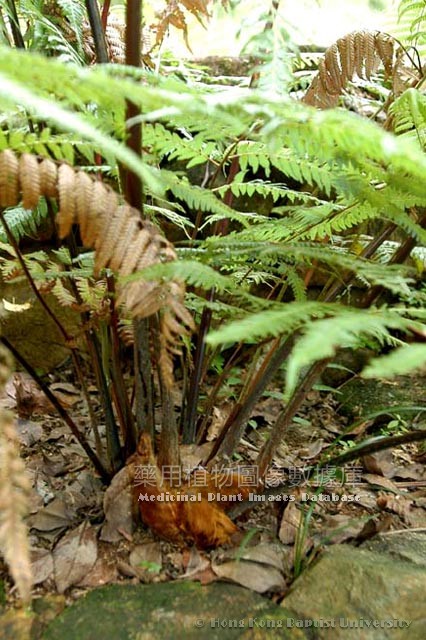
|
English Name |
Scythian Lamb, |
|
Latin name |
Cibotium barometz (L.) J. Sm. |
|
Family & Genus |
Dicksoniaceae, Cibotium |
|
Description |
Perennial tree ferns, plants 2.5-3m tall. Rhizomes prostrate, short and stout, 4-8cm in diameter, woody, with dense brown yellow and golden shiny long soft hairs, shiny, shaped like golden nugget. Leaves numerous, clustered into coronary, shape large; petioles stout, brown, 1-1.2m long, base 2-3cm thick, with dense golden yellow long soft hairs and yellow narrowly lanceolate scales, ventral with shallow longitudinal grooves, lower part brown purple; blades coriaceous or thick papyraceous, ovate, 1-1.4m long, 80-110cm wide, tripinnate parted, pinnae 10-15 pairs, alternate, with stalks, narrowly oblong, 50-60cm long, 20-25cm wide; bi-pinnae 18-24 pairs, alternate, with short stalks, linear-lanceolate, 13-15cm long, 2-3cm wide; terminate lobes 23-25 pairs, alternate, narrowly oblong or slightly sickle-shaped, 1-1.8cm long, 3-5mm wide, margin with blunt teeth, with sparse yellow hairs when young, then gradually deciduous; leaf veins pinnate, lateral veins forked. Sori borne at the top of lateral veins of margin, slightly oblong, each lobe with 2-12 pieces, indusium laterally lobed into double lip-shaped, brown. |
|
Distribution |
Growing in limesmarginis at mountain foot and on acid soil in dank forests. Can be cultivated. Distributed in South and Southwest China, Zhejiang, Jiangxi, Fujian, Taiwan, Hunan and etc. The medicinal materials are mainly produced in Fujian, Sichuan and etc. |
|
Part Used |
Medical part: rhizome. Chinese name: Gouji. |
|
Harvest & Processing |
Excavated in autumn and winter, removed silt and dried; or removed hard roots, petiole and golden yellow tomentum, cut into thick pieces and dried, that is “Unripe Gouojipian”; after stewed, sun-dried to 60%-70% dried, cut into thick pieces and dried, that is "Ripe Goujipian". |
|
Chemistry |
Rhizome contains aspidinol and 30% amylum and methanol extracted from hydrolyzed kaempferol. Golden yellow squame contains tannin and pigment. |
|
Pharmacology |
Continuous injection may clearly increase the intake of 86Rb by cardiac muscle. |
|
Properties & Actions |
Sweet, bitter, warm.Tonifying the liver and kidney, strengthening the lumbus and knees and curing rheumatism. |
|
Indications & Usage |
Used for relative weakness in the loins and knees, weakness of the lower limbs, rheumatic arthralgia.Oral administration: decocting, 10-15g; or made as medicinal liquor. External application: appropriate amount, fresh products smashed for application. Use with caution in cases of kidney deficiency and heat, inhibited urination or short, dark or inhibited voiding of urine. |
|
Examples |
1. Rheumatic osteodynia, weakness of waist and knee: cibotium barometz root and stem 18g, camphortree root, european verbena 12g each, euconmmia, teasel 15g each, Japan buttercup 9g, red two-toothed achyranthes 6g. Immerse into liquor and drink.
2. Lumbago and excess urine: cibotium barometz, papaya, cortex acanthopanacis, euconmmia. Decoct in water and swallow. |
| Link to |
 Chinese Medicinal Material Images Database
Chinese Medicine Specimen Database Chinese Medicinal Material Images Database
Chinese Medicine Specimen Database
|
|


