|
Asarum heterotropoides Fr. Schmidt var. mandshuricum (Maxim.) Kitag.
|
English Name |
Manchur Wildginger, Manchurian Wildginger |
|
Latin name |
Asarum heterotropoides Fr. Schmidt var. mandshuricum (Maxim.) Kitag. |
|
Family & Genus |
Aristolochiaceae, Asarum |
|
Description |
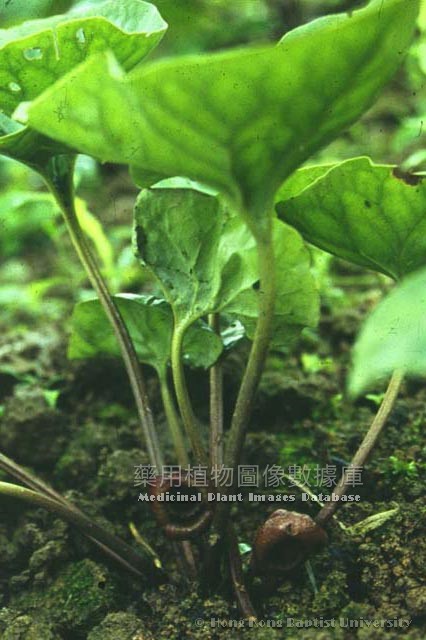
Perennial herbs, 12-24cm tall. Rhizome crablike, dense fibrous roots, with spicy fragrance. Stem short, base with 2-3 scales, stem end with 2-3 leaves; leaves with petioles, petiole 5-18cm long, glabrous, rare with short hairs, with shallow grooves; leaves ovate-cordate or nearly reniform, 4-9cm long, 5-13cm wide, apex obtuse or acute, base cordate, both sides auricular, margin entire, upper vein with hairs, sometimes other part also with sparse and extremely short hairs, lower hairs dense; sporophyll nearly round. Flowers solitary at axil, peduncles 3-5cm long, squarely bent when flowering, erect when fruiting. Perianth tube urceolate or semi-spherical, purple-brown, rare purple-green, inside with bulging edges; 3 lobes, triangular-ovate, slightly acute, 7mm long, 9mm wide, outwards reflexed from base, dirty brown-red; throat with annular constriction; stamens 12, 3mm long, filaments slightly shorter than anthers; semi-inferior ovary or nearly inferior ovary, 6-chambered, styles 6, apex 2 lobed, stigma pleurogenous. Capsules semi-spherical, diameter ca. 12mm. Seeds ovate conic, surface with black succulent aril. Flowering: May. Fruiting: June to July. |
|
Distribution |
Growing in forests, hillsides, dank and fertile places of ravine. Can be cultivated. Distributed in Northeast China, Shandong, Shanxi, Henan and etc. The medicinal materials are mainly produced in Heilongjiang, Jilin, Liaoning and etc. |
|
Part Used |
Medical part: entire plant. Chinese name: Xixin. |
|
Harvest & Processing |
Excavated in fruiting summer or early autumn, removed soil and dried in shade. |
|
Chemistry |
Contains alkaloid, volatile oil with at least 31 ingredients. |
|
Pharmacology |
Antifebrile, pain-relieving, anti-convulsion, anti-inflammatory, immunodepression, anti-nephropathy, local anesthesia, beneficial to respiratory system and cardiovascular system, antihistamine and anti-pathological changes. |
|
Properties & Actions |
Pungent, warm, mild-toxic.Removing wind, dispelling cold, stimulating meridians, alleviating pain, warming lung and dissipating phlegm. |
|
Indications & Usage |
Used for common cold induced by pathogenic wind-cold, headache, toothache, nasal obstruction and rhinorrhea with turbid discharge, rheumatic arthralgia, dyspnea with cough due to phlegm and retained fluids.Internal: decocting, 2-6g; or powdered, 1-3g. External: appropriate amount, powdered for blowing nose, stuffing in ears, compress on navel; or decocted for gargling. Use with care in case of deficiency of qi and hydrosis. Not use for fever, deficiency of yin and blood, etc. |
|
Examples |
1. Indigestion: wild ginger (removing leaves) 15g, cloves 7.5g. Grind into a powder. Take 3g with persimmon stem soup.
2. Treat wind entered into abdomen, remove pain, expelling restlessness: wild ginger, medicinal evodia, dried ginger, 15g each, angelica, divaricate saposhnikovia root, 30g each, peony 60g. Grind all drugs into powder, 15g each time, water 2 L, cook until 1L remains. Warm up and drink in 3 times. |
| Link to |
 Chinese Medicinal Material Images Database
Phytochemical Image Database Chinese Medicinal Material Images Database
Phytochemical Image Database
|
|


