|
Panax japonicus C. A. Mey.
|
English Name |
Japanese Ginseng, |
|
Latin name |
Panax japonicus C. A. Mey. |
|
Family & Genus |
Araliaceae, Panax |
|
Description |
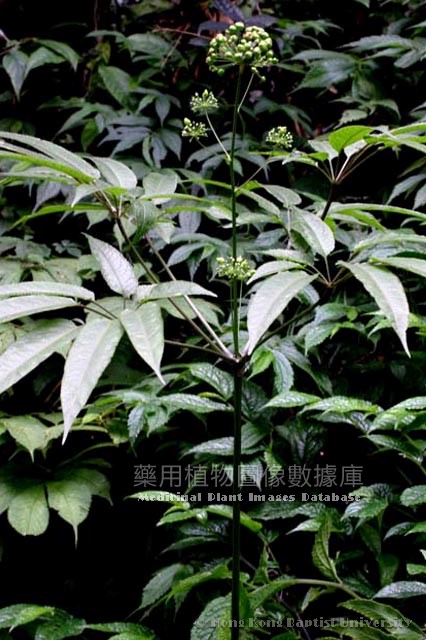
Perennial herbaceous, ca. 50-80cm tall. Fibrous roots, rhizomes short, erect, thick, internodes short, shallow cup-shaped stem, base marked per session, bamboo roots or beaded, lateral roots conical and fleshy. Palmately compound leaves 3-5 whorled at stem end; petioles 8-11cm long; leaflets 5, membranous, widely elliptic, elliptic to obovate-elliptic, rare elliptic-oblong, 5-18cm long, 2-6.5cm wide, usually middle widest, length 2-4 times of width, apex acuminate or long acuminate, base cuneate, round or nearly cordate, margin serrulate, double serrations or incised serrations, glabrous or sparsely setaceous along vein above, glabrous or sparsely setaceous or densely pubescent along vein below. Umbel solitary terminal, flowers numerous, peduncle ca. 12cm long, glabrous; flowers small, pale green, pedicels slender, glabrous, ca. 10mm long; calyx green, 5 teeth, triangular-ovate; petals 5, long-ovate, imbricate; stamens 5, filaments shorter than petals; pistil inferior ovary, 2 chambers, styles 2, middle and below fused, upper separated, fruiting anti-roll, flower disk fleshy, circular. Drupe-like berries spherical, red when mature. Seed 2-5, white, triangular-long-ovate. Flowering: May to June, fruiting: July to September. |
|
Distribution |
Growing in broad-leaved forest in valleys at altitude 1,800-2,600m. Can be cultivated. Distributed in Southwest China and Shaanxi, Gansu, Anhui, Zhejiang, Jiangxi, Fujian, Henan, Hunan, Hubei, Guangxi, Tibet and etc. The medicinal materials are mainly produced in Yunnan, Sichuan, Guizhou and etc. |
|
Part Used |
Medical part: rhizome. Chinese name: Zhujieshen. |
|
Harvest & Processing |
Excavated in autumn, removed taproot and bark and dried. |
|
Chemistry |
Contains saponins, mainly chiksersusaponin III. |
|
Pharmacology |
Anti-inflammatory, anti-aging and hpyerglycemic. |
|
Properties & Actions |
Sweet, little bitter, warm.Tonifying and invigorating, dissipating stasis to relieve pain, relieving hemorrhage and dispelling phlegm. |
|
Indications & Usage |
Used for physical asthenia after diseases, empsyxis due to pulmonary tuberculosis, coughing with asthma, excessive phlegm, and injuries from falls.Oral administration: 6-9g; triturated for administration. |
|
Examples |
1. Cough due to consumptive disease: Japanese ginseng 15g. Decoct in water and drink as tea.
2. Hematemesis: Japanese ginseng 9g, dwarf lilyturf 6g, simao root 9g. Decoct in water and swallow. |
| Link to |
 Chinese Medicine Specimen Database Chinese Medicine Specimen Database
|
|


