|
Panax japonicum C. A. Mey. var. major (Burk.) C. Y. Wu et K.m. Feng
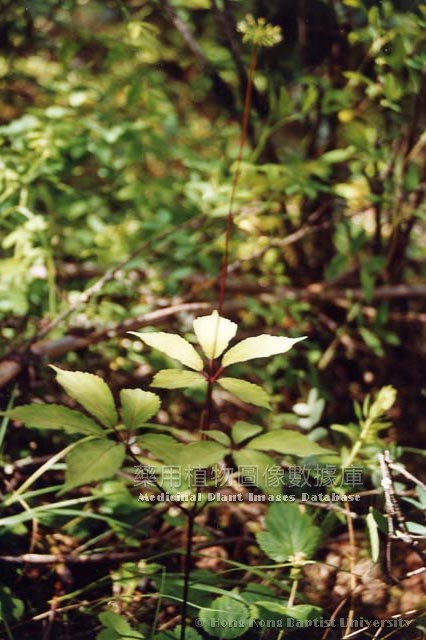
|
English Name |
Pearl Ginseng, |
|
Latin name |
Panax japonicum C. A. Mey. var. major (Burk.) C. Y. Wu et K.m. Feng |
|
Family & Genus |
Araliaceae, Panax |
|
Description |
Perennial herbaceous, ca. 80cm tall. Rhizome beaded, named Pearl Ginseng. Root usually not enlarged, fibrous, rarely lateral roots enlarge to conical and fleshy root. Stem single, glabrous, cylindrical, ribbed. Palmately compound leaves, 3-5 whorled at stem terminal, petioles small, ca. 9cm long; leaflets usually 5, lateral smaller, petiolule 5-15mm long, middle leaflet elliptic or ovate-elliptic, 10-13cm long, 5-7cm wide, apex long acuminate, base cuneate or nearly round, margin serrulate, serrate or incised-serrate, margin and vein on both side sparsely bristled. Umbel solitary at stem terminal, sometimes 1 or several small umbels below; rachis slender; calyx green, campanulate, terminal 5 lobate; petals 5, pale yellowish green, ovate-triangular; stamens 5, filament short; inferior ovary, 2 chambers (rare 4 chambers), styles usually 2 (rare 4), distinct. Drupe berry-like, spherical, red when mature, dark spots at terminal. Flowering: July to August, Fruiting: August to October. |
|
Distribution |
Growing on slopes, in bamboo groves, weeds or gutter at altitude 800-4,000m. Can be cultivated. Distributed in Gansu, Shaanxi, Ningxia, Shanxi, Henan, Anhui, Hubei, Hunan, Zhejiang, Jiangxi, Fujian, Guangxi and southwest and etc. The medicinal materials are mainly produced in Yunnan. |
|
Part Used |
Medical part: rhizome. Chinese name: Zhuzishen. |
|
Harvest & Processing |
Excavated in autumn, removed bark and fibrous roots, dried; or steamed (cooked) until well done then dried. |
|
Chemistry |
Contains variety of saponins, e.g. chikusetsusaponin. |
|
Pharmacology |
Immunity-enhancing, analgesia, sedative, anti-lipid peroxidation and experimental anti-ulcers. |
|
Properties & Actions |
Bitter, sweet, little cold. Bitter, sweet, little cold.Tonifying the lung and yin, activating collaterals to relieve pain. |
|
Indications & Usage |
Used for injuries from falls, hemorrhage caused by trauma, pain in loin and legs, irregular menstrual periods, hematemesis, hemafecia, empsyxis, hemorrhage caused by trauma, anthracia, gastralgia, laryngopharyngitis, parotitis. Prepared products for deficiency of qi and blood, coughing with asthma due to consumptive disease.Oral administration: 9-15g. External application: appropriate amount, powdered and scattered on the affected part. |
|
Examples |
1. Trachitis, bronchitis: an appropriate amount of pearl ginseng. Grind into powder, take 3g each time.
2. Traumatic hemorrhage: pearl ginseng, pestle and apply externally. |
|


