|
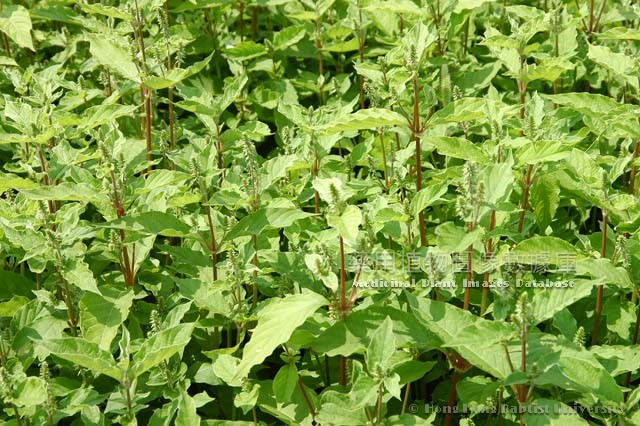
Achyranthes bidentata Blume
|
English Name |
Two-toothed Achyranthes, |
|
Latin name |
Achyranthes bidentata Blume |
|
Family & Genus |
Amaranthaceae, Achyranthes |
|
Description |
Perennial herbs. Radical stout and cylindrical, khaki. Stem erect, up to 1m, four prisms, leaves elliptic-lanceolate, 4-15cm long, 2-5cm wide, apex acuminate, base cuneate, entire, petioles 1-3cm long. Spikes acrogenous or axillary, up to 15cm, flowers yellowish-green, bracts wide ovate, calyx 5, stamens 5. Utricles oblong, outside with bracts. Flowering: May to August, fruiting: August to September. |
|
Distribution |
Growing on roadsides in hills. Distributed in Henan, Shanxi, Shandong, Jiangsu, Anhui, Zhejiang, Jiangxi, Hunan, Hubei, Sichuan, Yunnan, Guizhou and etc. The medicinal materials are mainly produced in Henan. |
|
Part Used |
Medical part: roots. Chinese name: Niuxi. |
|
Harvest & Processing |
Roots of Niuxi: excavated when leaves wither in winter, removed fibrous roots and soil, sun-dried to shriveling, smoked several times by sulfur, cropped the upper part and sun-dried. |
|
Chemistry |
Mainly contains saponins. |
|
Pharmacology |
Protein-assimilatiing, blood-pressure-reducing, intestines-influencing. |
|
Properties & Actions |
Sweet, bitter, sour, neutral, non-toxic.Promoting blood circulation to remove stasis, strengthening sinew and bone, inducing urination and treating stranguria, ensuring proper downward flow of blood, purging heat and detoxifying. |
|
Indications & Usage |
Dysmenorrhea, aggregation-accumulation, abdominal pain after giving birth, wilting disease, impediment disease, wrist and knee pain causing limp, blood strangury with syndrome of dampness-heat moving downward, inhibited urination, sharp pain in urethra, nosebleed, dizziness, abscess with swelling.Internal: decocting, 15-25g; made as medicinal liquor or prepared plaster or made as pills or powders. External: smashed for applying. |
|
Examples |
1. Retention of placenta after giving birth, corrupted placenta: achyranthis radix soup.
2. Liver wind, ascendant hyperactivity of liver yang, powered long and string-like pulse, or surging pulse upon with vacuous pulse below, frequently dizziness, or fever inside the brain, or distention of eyeball with tinnitus, or vexing heat in the chest, or frequently belching, or gradually inhibited body and limbs: Tranquilizing Liver-wind Decoction.
3. Lady's beriberi and foot edema, vexation, amenorrhea: achyranthis radix. |
| Link to |
 Chinese Medicinal Material Images Database
Chinese Medicine Specimen Database Chinese Medicinal Material Images Database
Chinese Medicine Specimen Database
|
|


