|
|
|
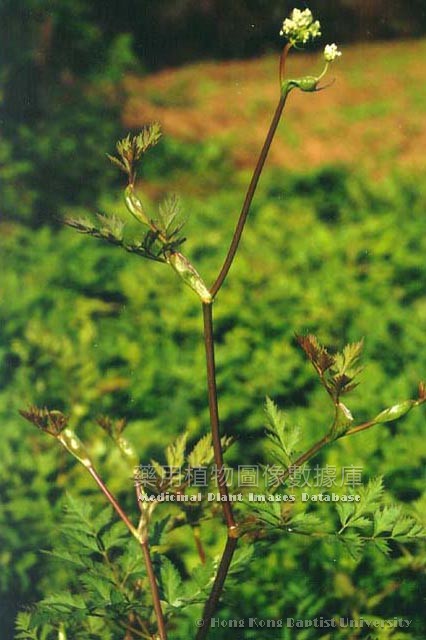
Ligusticum chuanxiong hort.
|
English Name |
Chuanxiong Ligusticum, |
|
Latin name |
Ligusticum chuanxiong hort. |
|
Family & Genus |
Apiaceae, Ligusticum |
|
Description |
Perennial herbs, 15-60cm tall. Stem upright, hollow, vertical edges on surface, often purple color. Cauline leaves alternate,lower and middle cauline leaves with long petiole; blade broadly deltoid, often trifoliolately tripinnatisect, terminal lobes ovate or broadly ovate, apex acuminate, base cuneate or nearly orbicular, margin has few teeth like incisions; upper leaves small, petiole sheathing, dipinnatisectly trifoliolate. Compound umbel acrogenous; phyllaries few, caduceus; peduncles 6-19; involucral bracteole basiconic, ca. 10, pedicel ca. 20; calyx-tooth inconspicuous; petals 5, white, elliptic; stamens 5, longer than petals, anther black purple; inferior ovary, style flattened basiconic. Cremocarp elliptic, mericarp ribs 5, ribs narrow-winged, vittae 1 in each furrow of dorsal ribs, 1-2 in each furrow of lateral ribs, 2-4 in commissure. Flowering: July to September. Fruiting: September to October. |
|
Distribution |
Mostly cultivated. Distributed in Sichuan, Guizhou, Yunnan and etc. The medicinal materials are mainly produced in Guanxian and Chongqing of Sichuan. |
|
Part Used |
Medical part: rhizome. Chinese name: Chuanxiong. |
|
Harvest & Processing |
Excavated rhizome from late May to early June on the second year of planting; removed stem leaves and fibril, washed, sun-dried or baked to dry, and then strike out fibril. |
|
Chemistry |
Rhizome contains volatile oils, alkaloids, phenol components, lactones and ferulic acid. |
|
Pharmacology |
Sedative and vasculature-expanding. |
|
Properties & Actions |
Pungent, warm, non-toxic.Promoting qi-flowing and opening depression, dispelling wind and eliminating dampness, promoting blood circulation for suppressing pains. |
|
Indications & Usage |
Headaches caused by wind chill, vertigo, costal and abdominal pain, cold hypochondrium protrusion and spasms, menostasia.Oral administration: decocting, 3-10g; or made as pills or powders. External application: powdered for dusting or applied after mixed with fluid. |
|
Examples |
1. Treat retention of afterbirth, deficiency of vital energy due to delivery in mother: szechwan lovage rhizome, angelica 2 qian each, cortex cinnamomi 4 qian. Decoct the above two drugs in water and swallow.
2. Treat headache due to pathogenic wind-heat: szechwan lovage rhizome ligusticum 1 qian, tea 2 qian. Decoct a cup of water to 5 fen, warm up and swallow before meals.
3. Treat hemicrania, head-wind: chamomile, cypsum fibrosum, szechwan lovage rhizome ligusticum 3 qian each. Grind into powder. Take 1 qian each time, swallow with clear tea. |
| Link to |
 Chinese Medicinal Material Images Database
Phytochemical Image Database
Chinese Medicine Specimen Database Chinese Medicinal Material Images Database
Phytochemical Image Database
Chinese Medicine Specimen Database
|
|
Permanent URL:https://sys01.lib.hkbu.edu.hk/cmed/mpid/detail.php?herb_id=D00116 |
|
|
|


