|
|
|
Carthamus tinctorius L.
|
English Name |
False Saffron, Safflor |
|
Latin name |
Carthamus tinctorius L. |
|
Family & Genus |
Asteraceae, Carthamus |
|
Description |
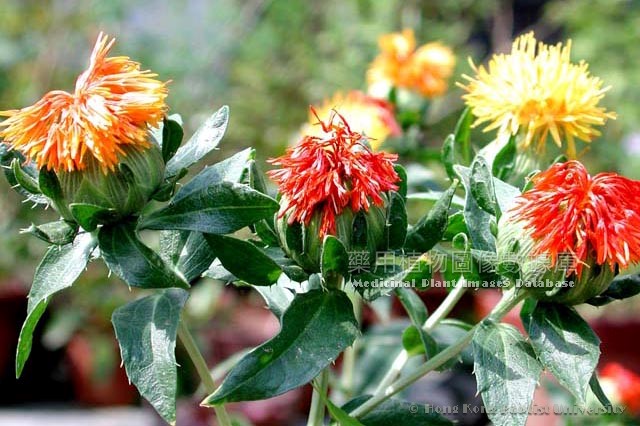
Perennial herb, 50-100cm. Stem upright, branching upper stem, white or pale white, glossy alternate leaves; sessile; lower middle cauline leaves lanceolate, ovate- lanceolate or oblong. 7-15cm long, 2.5-6cm wide, margin big-serrations, biserrate, small-serration or entire, rarely P447pinnate parted, spindle on top of teeth, 1-1.5mm; leaves smaller upward, lanceolate, margin serrated, spindle on top of teeth longer, up to 3mm; all leaves hard, coriaceous, both sides hairless, no glands, glossy. Capitulum many, ranged to corymb on the top of stem, surrounded by bracts; bracts ellipitic or ovate- lanceolate, length 2.5-3cm with spindle of apex, margin spiniferous or no spindle; phyllary diameter 25cm; phyllary 4 layers, outer layer harp-like, lower and middle part shrunken, the part above shrunken green, margin does not have spindle or is spiniferous, the part below shrunken yellow-white; middle inner layer hard-membranous, oblanceolate-elliptic to long-oblanceolate, up to 2.2cm, apex acuminate; all bracts hairless, no glands; florets red or orange-red, monoclinous, corolla length 2.8cm, corolla tube length 2cm, corolla lobe almost near the base. Achene obovate, 5.5mm long, 5mm wide, milky white, with 4 ribs, no pappus. Flowering: May to August. Fruiting: May to August. |
|
Distribution |
Growing in warm and dry weather; cold-, drought- and salinity- resistant. Widely cultivated in Northeast, North and Northwest China, Shandong, Zhejiang, Guizhou, Sichuan, Tibet and etc. The medicinal materials are produced in Yanjin and Fengqiu of Henan, Zhejiang Cixi and Yuyao of Zhejiang, Jianyang and Suining of Sichuan. Mass cultivated in Sichuan and Henan. |
|
Part Used |
Medical part: tubular flowers without ovary. Chinese name: Honghua. |
|
Harvest & Processing |
Flowering starts from late May, and bloom in Late May to mid- and late June. Picked in batches. Harvested at 6-8 a.m. on sunny days. Harvested when tubular flowers fully developed and become golden color. Or tubular flowers will wither and become red-black, of low quality and quantity. Dried or dried in 40℃-60℃. |
|
Chemistry |
Flowers contain red and yellow pigments. These compositions can be separated from it: carthamin, precarthami, safflow yellow A and B, safflomin A. Also contains polyphenols: chlorogenic acid, caffeic acid, cate-chol, pyrocatechol and dopa. |
|
Pharmacology |
Pharmacological on the cardiovascular system. |
|
Properties & Actions |
Pungent, warm.Activating blood to unblock the meridian, dispelling stasis to relieve pain. |
|
Indications & Usage |
Menostasia, algomenorrhea, postpartum abdominal pain due to blood stasis, dysfunction of the urinary bladder, cardiodynia and abdominal mass, injuries caused by falls, arthralgia, stroke and hemiparalysis, macular eruptions.Internal: decocting, 3-10g. Fewer amounts used for nourishing blood; more for activating blood and dissipating stasis. |
|
Examples |
1. Treat algomenorrhea: false saffron 6g, spatholobus stem 24g. Decoct in water, mix with yellow wine of an appropriate volume, and drink.
2. Treat swelling pain due to arthritis: parch saffron, grind into powder, add sweet potato powder of equal amount, prepare with salty water or distilled liquor, and apply onto the affected lesion. |
| Link to |
 Chinese Medicinal Material Images Database
Chinese Medicine Specimen Database Chinese Medicinal Material Images Database
Chinese Medicine Specimen Database
|
|
Permanent URL:https://sys01.lib.hkbu.edu.hk/cmed/mpid/detail.php?herb_id=D00156 |
|
|
|


