|
Stemmacantha uniflora (L.) Dittrich
|
Latin name |
Stemmacantha uniflora (L.) Dittrich |
|
Family & Genus |
Asteraceae, Stemmacantha |
|
Description |
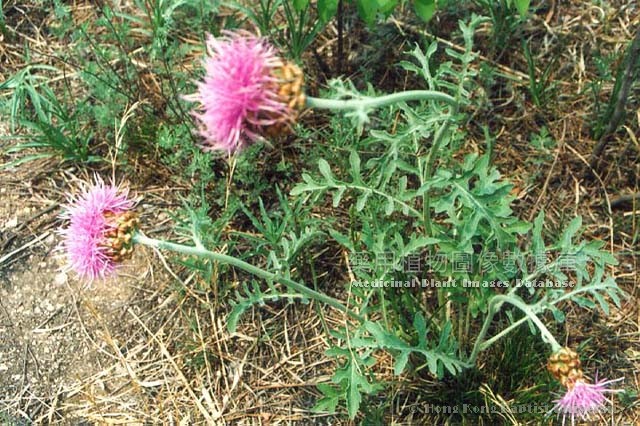
Perennial herb, 30-100cm high. Rhizomes thick, taproot cylindrical, diameter 1-2cm. Stems clustered or solitary, erect, greyish white, with tomentum. Basal leaves with long stalk, petiole length 6-20cm, covered with thick tomentum; basal leaves and lower stem and leaves oval, length 12-25cm, width 5-10cm, pinnately parted, lobes often pinnately parted again, lateral fissures 5-12 pairs; middle and upper leaves smaller; with short stalk, both surfaces greyish white, with rough hair and yellow small glandular dots. Capitulum solitary on top of stem; Involucre hemispherical, diameter 3.5-6cm; involucral bracts 9 layers, apex with membranous broadly ovate appendage, middle layer elliptic or lanceolate, inner lanceolate, apex acute; corolla purplish red, bisexual, tubular, ca. 2.5cm long, apex 5 cleft; Stamens 5, anthers aggregated; ovary inferior, style extended out, stigmas 2 cleft, purple. Achenes, cuneate, 5-6mm long, with 3-4 edges, brown; pappus rough-hair shape, multilayer, growing toward inner layer gradually. Flowering: May to July, fruiting: June to August. |
|
Distribution |
Growing in hills, pine forests or birch forests at altitude 390-2,700m. Distributed in Northeast China, Inner Mongolia, Hebei, Shanxi, Shaanxi, Gansu, Qinghai, Shandong, regions south of the Yangtze River, Sichuan and etc. The medicinal materials are mainly produced in Tangshan, Zunan and Qianan of Hebei, Suizhong and Chaoyang of Liaoning and Yuci of Shanxi. |
|
Part Used |
Medical part: roots. Chinese name: Loulu. |
|
Harvest & Processing |
Collected in late autumn, removed soil, used fresh or sundried. |
|
Chemistry |
Contains volatile oil. |
|
Pharmacology |
Anti-atherosclerosis, antioxidant, hepatic-protective and immunity-strengthening. |
|
Properties & Actions |
Bitter, cold.Clearing heat, detoxifying; activating blood and inducing lactation. |
|
Indications & Usage |
Ulcer, furuncle and swelling toxicity, mammary abscess, parotid bubo, lymphoid tuberculosis, hemorrhoids and fistula, scabies and prurigo, swelling pain induced by conjunctival congestion, dysentery, enterozoic abdominalgia, rheumatic arthralgia, lumbar sprain and pain in the sternal rib, injuries from falls, lack of lactation after delivery.Oral administration: decocting, 9-15g. External application: appropriate amount, powdered and mixed with vinegar for application; or fresh material triturated for application. Not use in case of skin and external diseases or pregnant, etc. |
|
Examples |
1. Treat carbuncle and sores: globethistle 15g, weeping forsythia 9g, amoorcorn tree bark 12g, rhubarb, ural licorice 3g each, Decoct in water and swallow.
2. Treat red swelling due to mammary abscess: globethistle, mongolian dandelion, flos lonicerae 15g each, raniculate bolbostemma 9g, ural licorice 6g, decoct in water and swallow.
3. Treat epidemic parotitis: globethistle 4.5g, isatis root 3g, edible burdock 1.2g, ural licorice 1.5g, decoct in water and swallow. |
|


