|
Silybum marianum (L.) Gaertn.
|
English Name |
St. Mary’s Thistle, Blessed Thistle, Holy Thistle, Milk Thistle |
|
Latin name |
Silybum marianum (L.) Gaertn. |
|
Family & Genus |
Asteraceae, Silybum |
|
Description |
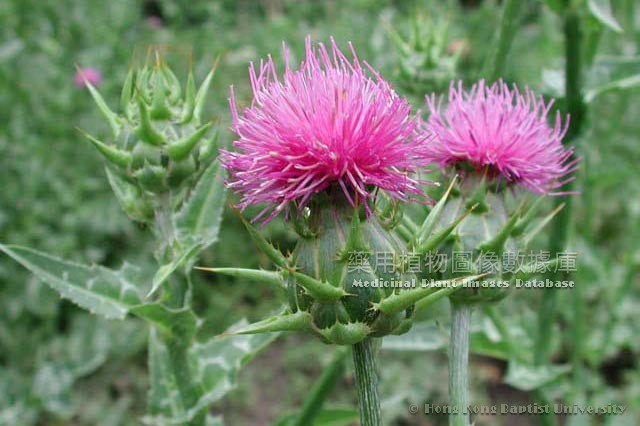
Annual or biennial herb, 30-120cm high. Stem erect, much branched, with white powdery coatings. Basal leaves large, rosulate, petiolate, leaf blade elliptic or long lanceolate, 15-40cm long, 6-14cm wide, pinnately parted to divided, marginal tooth with hard thorns, leaves with milky white stripes, short hairy below, veins with long hispid, midrib conspicuous on dorsal surface of leaves; Cauline leaves smaller, long ovate or lanceolate. Capitulum, diameter 4-6cm, terminal or axillary, pendulous; involucre globose; involucral bracts 6 layers, glabrous, middle and outer layer broadly spathulate, elliptic, or lanceolate, upper part rounded, triangular rigid foliaceous appendages, edge with hard spines, inner bracts linear-lanceolate; floral receptacle carnose, with hard receptacle hair; all flowers being tubular flowers, bisexual; light purple or purplish red, rarely white. Achenes, elliptic, ca. 7mm long, brown or dark brown, surface with vertical stripes, glands protuberant; pappus white, serrated, the innermost pappus flocculent. Flowering and fruiting: May to October. |
|
Distribution |
Growing in ventilated, cool, dry, sunny and desolate beach-lands or saline-alkali soil, etc. Originating in South Europe and North Africa, now introduced for cultivation in North and Northwest China. The medicinal materials are mainly produced in North and Northwest China. |
|
Part Used |
Medical part: fruits. Chinese name: Shuifeiji. |
|
Harvest & Processing |
Collected in summer and autumn, and sun-dried. |
|
Chemistry |
Contains dihydrokaemp-ferol, silybin, silydianim, silychristin, linolenic acid, linoleic acid, olic acid, behenic acid, silymonin, silandrin, isostlychristin and quercetin. |
|
Pharmacology |
Hepatic-protective, blood-fat-reducing, anti-atheromatous plaque, cardiovascular-system-affecting and cerebral-ischemia-protecting, and anti-platelet-aggregating. |
|
Properties & Actions |
Bitter, cool.Clearing heat and disinhibiting dampness, soothing liver-gallblader. |
|
Indications & Usage |
Chronic hepatitis, cirrhosis, adiposis hepatica, cholelithiasis, angiocholitis.Oral administration: decocting, 6-15g; or made as electuary, capsule or pills. |
|
Examples |
1. Silybin powder preparation for infusion: silybin 7.7g, citric acid 6g, natrium citricum 10g, starch sugar 10g, sodium carboxymethycellulose 2g, tween-80 of an appropriate amount, sugar powder of an appropriate amount. It can be used to treat acute and chronic hepatitis and translation hepatitis. Take the drug orally with boiled water, 20g at each time, 3 times a day.
2. Silybin capsule: hard capsule prepared with extracts of St. Mary's Thistle fruit. Each capsule contains 38.5g silybin. The product's contents are pale yellow or yellow. It has liver improving effects, and can stabilize the hepatic membrane, and treat acute and chronic hepatitis as well as translation hepatitis. Take the drug orally, 2 capsules each time, 3 times a day, and 3 months as a treatment course. |
| Link to |
 Chinese Medicinal Material Images Database Chinese Medicinal Material Images Database
|
|


