|
Siegesbeckia orientalis L.
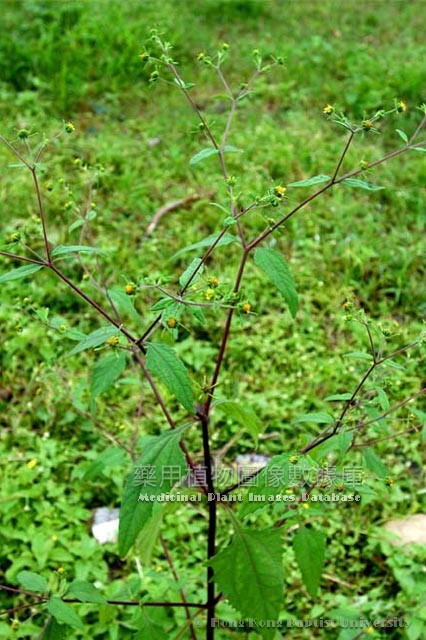
|
English Name |
Shrimp Claw Plant, |
|
Latin name |
Siegesbeckia orientalis L. |
|
Family & Genus |
Asteraceae, Siegesbeckia |
|
Description |
Annual herb, 30-100cm high. Erect, upper branches often compound dichotomous, all branches grey-white pubescent. Leaves opposite; basal leaves wither at flowering; middle leaves triangular ovate or ovate-lanceolate, 4-10cm long, 1.8-6.5cm wide, apex acuminate, base broadly cuneate, decurrent into winged stalk, margin irregularly lobed or coarsely toothed, green above, light green below, with glandular dots, both surfaces hairy, ternate basal veins, lateral veins and reticulate veins conspicuous; upper leaves attenuate, ovate-oblong, margin shallowly undulate or entire, subsessile. Capitulum numerous, aggregated to be terminal panicle; pedicels 1.5-4cm long, densely pubescent; involucre broadly campanulate; involucral bracts 2 layers, foliaceous, dorsal surface with violet brown capitate stipitate glandular hairs, outer bracts 5-6, linear spathulate or spathulate, extended, length 8-11mm, width about 1.2mm; inner bracts ovate oblong or ovoid, ca. 5mm long, width about 1.5-2.2mm; outer stipule blades oblong, incurved, inner stipule blades obovate-oblong; flowers yellow; tubular part of corolla of female flower about 0.7mm long; the upper part of amphoteric tubular flower campanulate, upper end with 4-5 oval lobes. Achenes obovoid, with 4 ridges, apex with greyish-brown protuberance, length 3-3.5mm, width 1-1.5mm. Flowering: April to September, fruiting: June to November. |
|
Distribution |
Growing in mountains, wild grasslands, thickets and forests at altitude 100-2,700m. Distributed in Shaanxi, Gansu, Jiangsu, Anhui, Zhejiang, Jiangxi, Fujian, Hunan, Guangdong, Hainan, Guangxi, Sichuan, Guizhou, Yunnan and etc. The medicinal materials are produced in Qinling Mountains and the south of the Yangtze River. |
|
Part Used |
Medical part: entire plant, roots and fruits. Chinese name: entire plant: Xixiancao; roots: Xixiangen; fruits: Xixianguo. |
|
Harvest & Processing |
Xixiancao: collected in summer before or in flowering. Harvested aboveground part, half sun-dried, placed in dried and ventilate area and dried in shade. Xixiangen: excavated in autumn and winter, well washed, cut up and used fresh. Xixianguo: collected in summer and autumn, and sun-dried. |
|
Chemistry |
Contains costunolides and nerol. |
|
Pharmacology |
Anti-inflammatory, hypertension-reducing, vasodilatation, antibacterial, anti-malaria, having effect on the immune system of laboratory rat, thrombosis of rabbit. |
|
Properties & Actions |
Bitter, pungent, cold, mild-toxic.Xixiancao: removing wind and damp, warming meridians, clearing heat and detoxifying. Roots: removing wind, eliminating damp, promoting tissue regeneration. Fruits: dispelling parasites. |
|
Indications & Usage |
Common St. Paulswort: Mainly indicated for rheumatic arthralgia, discomfort in bones and muscles, asthenia of waist and knee, hemiparalysis, hypertension, malaria, jaundice, anthracia, sores, eczema of lower limb, insect and animal bites. Common St. Paulswort root: rheumatism and obstinate arthralgia, head-wind, leukorrhea, burns and scalding injury. Common St. Paulswort fruit: ascariasis.Xixiancao: oral administration: decocting, 9-12g, megadose 30-60g; extract juice or made as pills or powders. External application: appropriate amount, triturated for application; or powdered and scattered; or prepared decoction for fumigating and washing. Root: oral administration: decocting, fresh products 60-120g. External application: appropriate amount, triturated for application. |
|
Examples |
1. Treat chronic nephritis: shrimp claw plant 30g, lesser St. John's wort 15g. Decoct in water, infuse with brown sugar, and swallow.
2. Treat neurastheria: shrimp claw plant, dan-shen 15g each. Decoct and swallow.
3. Treat discharging fresh blood stool: siegesbeckiae herba leaves, setam in liquor, prepare into honey pills. Take 9g each time with plain soup. |
| Link to |
 Chinese Medicinal Material Images Database
Chinese Medicine Specimen Database Chinese Medicinal Material Images Database
Chinese Medicine Specimen Database
|
|


