|
|
|
Gentiana scabra Bge.
|
English Name |
Rough Gentian, |
|
Latin name |
Gentiana scabra Bge. |
|
Family & Genus |
Gentianaceae, Gentiana |
|
Description |
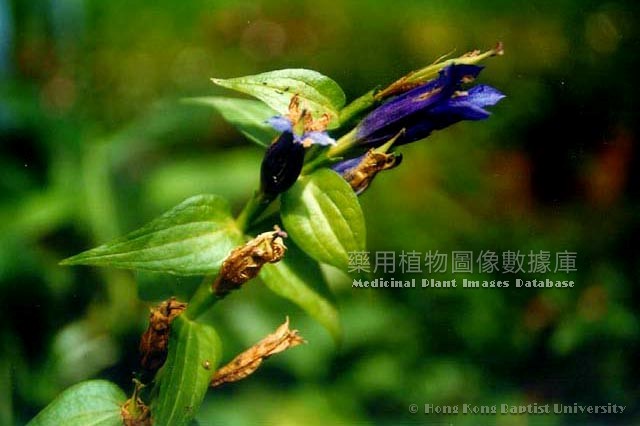
Perennial herb, whole plant green. Rhizome short, densely grown with yellowish white wrinkled roots, up to 30cm long. Stem upright. Leaf opposite, sessile; basal part slightly embracing stem, basal leaf of stem 2-3 pairs, round or scale like, middle leaf comparatively big, ovate or ovate lanceolate, 3-7cm long, 1-2cm wide, tip suddenly sharpened, margin coarse, with 3 distinct main veins. Flower fasciated on stem end or leaf axil, subtending leaf lanceolate, nearly equal to calyx in length, calyx campanulate, calyx tube truncate, about 2.5cm long, with 5 lobes in the tip; corolla tube tubularly campanulate, bright blue or deep blue, 4-5cm long, with 5 lobes in the tip, lobe ovate, tip sharp, lobe wrinkle triangular, about half of corolla in length; stamens 5, filament base with broad wings; style short, stigma with 2 lobes. Capsule oblong, with short stipe; seed plentiful, margin with wings. Flowering: September to October. Fruiting: October. |
|
Distribution |
Growing on mountain slope tussock, thickets and forest edges. Distributed in Heilongjiang, Jilin, Liaoning, Inner Mongolia, Hebei, Shandong, Jiangsu, Anhui, Zhejiang, Fujian, Jiangxi, Hunan, Hubei, Guizhou, Sichuan, Guangdong, Guangxi and etc. The medicinal materials are mainly produced in Northeast China. Produced in all parts of China except Northwest China and Tibet. |
|
Part Used |
Medical part: root and rhizome. Chinese name: Longdan. |
|
Harvest & Processing |
Collected in spring and autumn. Better in spring. After excavated, removed cauline leaf, well washed, and sun-dried. |
|
Chemistry |
Mainly contains gentiopicroside. |
|
Pharmacology |
Anti-bacterial, diuretic. |
|
Properties & Actions |
Bitter, cold.Clearing excess fire of liver and gallbladder, removing downward flow of damp and heat. |
|
Indications & Usage |
Excessive heat in the liver meridian, frightened epilepsy and madness, encephalitis B, headaches, conjunctival congestion, pharyngalgia, jaundice, heat type dysentery, furuncles and ulcers, swelling pain in the scrotum, damp itching in private parts.Oral administration: decocting, 5-15g; or made as pills or powders. External application: powdered for application. |
|
Examples |
1. Treat rheumatism and damp heat of lower body, swelling pain from below the umbilicus to feet, cold-dampness and beriberi.
2. Treat conjunctival congestion, swelling eyes, erupted stasis, and unbearable pain. |
| Link to |
 Chinese Medicinal Material Images Database
Chinese Medicine Specimen Database Chinese Medicinal Material Images Database
Chinese Medicine Specimen Database
|
|
Permanent URL:https://sys01.lib.hkbu.edu.hk/cmed/mpid/detail.php?herb_id=D00244 |
|
|
|


