|
Rosmarinus officinalis L.
|
English Name |
Rosemary, |
|
Latin name |
Rosmarinus officinalis L. |
|
Family & Genus |
Lamiaceae, Rosmarinus |
|
Description |
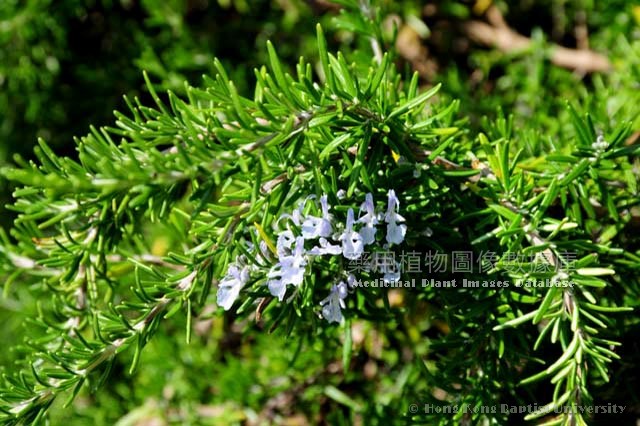
Shrub, up to 2m high. Stems and old branches cylindrical, bark dark grey, irregular longitudial split, massive peeling off, young branchlets densely white stellate tomentulose, tetragonal. Leaves often clustered on the branches; Sessile or short petiole; Leaf blade herbaceous, linear, 1-1.2cm long, 1-2mm wide, apex obtuse, base attenuate, entire, curling towards dorsal surface, nearly glabrous above, densely white stellate tomentose below. Flowers subsessile, opposite, forming racemes on the top of short branches; Bracts small, petiolate; calyx ovoid, campanulate, about 4mm long, white stellate tomentose and with glands, inside glabrous, veins 11, bilabiate, the upper lip suborbicular, entire or with 3 very short teeth, lower lip with 2 teeth, tooth oval triangular; corolla blue purple, light blue or white, length less than 1cm, outside sparsely pubescent, inside glabrous, corolla cylinder extending out, enlarged at throat, corolla limbs bilabiate, upper lip straight, 2 lobed, lobes ovate, lower lip broad, 3 cleft, middle lobe largest, concave, declinate, margin dentate, base constricted into stalk, lateral lobes oblong; fertile stamens 2, inserted under the upper lip of corolla, the middle part of filaments with one recurved tooth, anther cells 2, parallel, only one chamber developed; style slender, far more than the stamens, apex unequally 2-lobed, lobes subulate, anterior lobes longer; disk flat-topped, with equal lobes; ovary lobes alternate with disk lobes. Flowering: November. |
|
Distribution |
Originating from Mediterranean areas of Europe and Africa. Introduced for cultivation in gardens in China. There has been no main producing area till now. |
|
Part Used |
Medical part: whole plant. Chinese name: Midiexiang. |
|
Harvest & Processing |
Harvested from May to June, well washed, chopped into segments, and sun-dried. |
|
Chemistry |
Whole plant contains hesperidin, dios-min, cirsimarin, phegopolin, eupafolin-3-O-glucoside, eupafolin-4-O-glucoside, homoplantagi-nin, nepetrin, apigetrin, luteolin-3-O-glucuronide [1], luteolin-7-glucoside, 5-hydroxy-4, 7-dimethoxyflavone, 4, 5-dihydroxy-7-methoxyflavone, carnosol, rosmaricine, isorosmaricine, epi-α-amyrin, α-amyrin, β-amyrin, betulin, β-sitosterol, genkwanin, 7-ethoxyrosmanol, rosmanol, 7-methoxyrosmanol, ursolic acid, 19α-hydroxyursolic acid, 2β-hydroxyoleanolic acie, betulinic acid, rosmarinic acid and carnosic acid. |
|
Pharmacology |
Antimicrobial, cholagogic and menstruation-promoting. |
|
Properties & Actions |
Pungent, warm.Diaphoresis, invigorating spleen, calming mental state and suppressing pains. |
|
Indications & Usage |
Mainly indicated for various headaches, prevents early alopecia.Oral administration: decocting, 4.5-9g. External application: appropriate amount, steeped in water for washing. |
|
Examples |
Rosemary administered orally to treat dyspepsia, or as supportive therapy against rheumatism and circulatory diseases. In European medicine, it is adopted to treat dyspepsia, gastralgia, headache, and nervousness due to aerogastria. Immerse rosemary and smear externally onto the scalp to promote growth of hair, and treat alopecie. |
|


