|
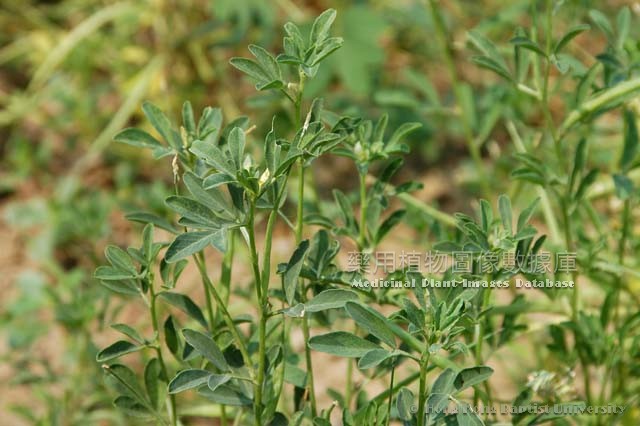
Trigonella foenum-graecum L.
|
English Name |
Fenugreek, |
|
Latin name |
Trigonella foenum-graecum L. |
|
Family & Genus |
Fabaceae, Sophora |
|
Description |
Annual herb, 30-80cm high. Main root deep and long, root system developed. Whole plant aromatic. Stem cylindrical, upright, branches plentiful, sparsely covered hairs. Pinnated ternately compound leaf, alternate; petiole 1-4cm long; leaflet 3, basidixed aphlebia invert ovate or oblong lanceolate, 1-4cm long, 0.5-1.5cm wide, blunt and round in the tip, basal part wedge shaped, margin upside with triangular sawtooth, both sides covered with sparse soft hairs or hairless, with comparatively long petiolule, lateral leaflet comparatively small, lateral vein 5-7 pairs; stipule connected with petiole, broadly triangular, tip gradually pointed, covered with hairs, membranous, entire, with hairs. Flower 1-2 and axillary, sessile; calyx tubular, 7-8mm long, covered with long soft hairs, calyx teeth lanceolate, nearly equal to calyx tube in length; corolla papilionaceous, yellowish white or light yellow, basal part slightly purplish, vexil long circular, deep-sinuately sunken on the top, clearly longer than ala or carina, ala long circular, carina square invert ovate, stamens 10, 9 pieces accrete in bundle, 1 piece separated; ovary linear, slightly covered with soft hairs, style short, stigma head shaped. Pod linearly cylindrical, straight or slightly sickle-like curled, hairless or slightly covered with soft hairs, with a thin and long rostellum in the tip, with longitudinal net stripes on the surface, 7-12cm long, 4-5mm in diameter. Seed 10-20, nearly elliptic, slightly flat, yellowish brown, surface uneven, 3-5mm long, 2-3mm wide. Flowering: April to July, fruiting: July to September. |
|
Distribution |
Growing on fields and roadsides. Mostly cultivated or wild. Distributed in Northeast and Southwest China, Shaanxi, Gansu, Xinjiang, Anhui, Zhejiang, Shandong, Jiangsu, Hebei, Henan, Hubei and Guangxi. The medicinal materials are mainly produced in Anhui, Sichuan, Henan and etc. |
|
Part Used |
Medical part: seeds. Chinese name: Huluba. |
|
Harvest & Processing |
Cut the whole plant in summer when fruits mature, sundried, knocked down seeds. |
|
Chemistry |
Mainly contains alkaloids, fatty acids, saponins and flavonoid. |
|
Pharmacology |
Antiandrogen and anti-fertile, lactation-stimulating and anti-tumors. |
|
Properties & Actions |
Bitter, warm.Warming the kidney, suppressing pains and dispersing cold. |
|
Indications & Usage |
Cold caused by deficiency in kidney, cold air in lower abdomen, cold-damp beriberi, intestinal hernia.Oral administration: decocting, 4.5-9g; or made as pills or powders. Use with caution in cases of excess fire due to yin deficiency or damp-heat. |
|
Examples |
1. Renal cold caused by deficiency, distension of abdomen and costal part: Fenugreek 2 liang, aconite root (prepare and break open, remove peel, insula), sulfur grundum (grind) 5 fen each. For the above three drugs, pestle and grind into powder, cook in liquor and prepare paste pills as large as firmianae semen. Take 20-30 pills each time with salty soup.
2. Headache induced by qi attack: Fenugreek (stir-fried), rhzoma sparganii (immerse in liquor, bake) 0.5 liang each, dry ginger (prepared) 2.5 qian. Grind the above drugs into fine powder. Take 2 qian each time, warm up fresh ginger soup, and swallow with liquor at any time.
3. Cold damp beriberi, pain of legs and waist, weak and unable to walk: Fenugreek 4 liang (immerse for one night), broken old paper 4 liang (stir-fried). Grind the above drugs into fine powder. Use 1 big papaya, cut off apex and remove pulp. Fill in drugs, and then cover with the apex. Fix with bamboo pick, steam and pick out, pestle. Prepare pills as large as firmianae semen. Swallow 50 pills each time with warm liquor on an empty stomach before meals. |
| Link to |
 Chinese Medicinal Material Images Database Chinese Medicinal Material Images Database
|
|


