|
Astragalus membranaceus (Fisch.) Bunge
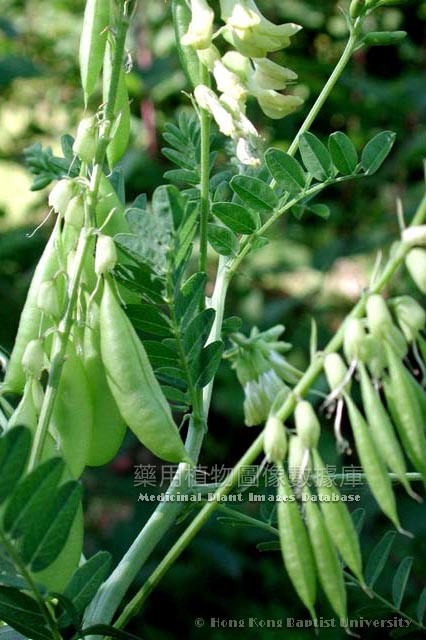
|
Latin name |
Astragalus membranaceus (Fisch.) Bunge |
|
Family & Genus |
Fabaceae, Astragalus |
|
Description |
Perennial herbs, 50-100cm tall. Main root deep, long and stout, rodshaped, slightly woody, usually branched, grey. Stem erect, upper mostly branched, with fine edges, smooth and occasionally white pubescence. Odd-pinnate compound leaves alternate; petioles 0.5-1cm long; leaflets -13 pairs, leaflets elliptic or ovate- lanceolate, 5-30mm long, 3-12mm wide, apex obtuse or slightly concave, with short cusps or not prominent, base round, margin entire, upper smooth or slightly covered with hairs, lower has some white long pubescence; stipules, linear-lanceolate, lanceolate or ovate, distinct, 4-10mm long, upper white pubescent or nearly sessile. Raceme axillary, with 10-25 flowers, loosely arranged; bracts linear-lanceolate, back white pubescent; small pedicel with black seta, 3-4mm long; calyx campanulate, 5-7mm long, calyx teeth 5, short, with black short hairs or black pubescence only on margin of calyx teeth, triangular to subulate; corolla pale yellow or yellow, papilionaceous, ca. 16mm long, vexillum oblong-obovoid, apex slightly concave, base with short petal handle, winged stems shorter than vexillum, oblong, base with short ear, and tropis both with long claws, petal handle ca. 1.5 times longer than limb, length of winged stem and tropis nearly the same, base long stalk-like; stamens 10, diadelphous; ovary sparsely pubescent, ovary stalk long, style glabrous. Pod thinly membranous, slightly bulging, semi-elliptic, 2-3cm long, 0.8-1.2cm wide, apex spiny, black or white short hairs on both sides. Seeds 3-8, black, reniform. Flowering: June to August; Fruiting: July to September. |
|
Distribution |
Growing on sunny mountain slopes, thickets edges, sandy riverbanks and grasslands on grounds. Distributed in Heilongjiang, Jilin, Liaoning, Inner Mongolia, Qinghai, Sichuan, Tibet, Shandong, Jiangxi, Shaanxi, Gansu, Hebei and etc. The medicinal materials are mainly produced in Heilongjiang, Jilin, Inner Mongolia, Hebei and etc. |
|
Part Used |
Medical part: roots. Chinese name: Huangqi. |
|
Harvest & Processing |
Excavated in spring and summer. Removed fibrous roots and root ends, sun-dried; or beveled into thick slices and dried. |
|
Chemistry |
Mainly contains astragaloside I, II, III, IV, V, VI, VII, VIII, and soyasaponin, etc. |
|
Pharmacology |
Influential on immune system, body metabolization, hematopoietic function and cardiovascular system, anti-viral and anti-cancer. |
|
Properties & Actions |
Sweet, warm.Fresh used: tonifying qi and strengthening exterior, inducing urination, detoxifying, discharging pus, curing wound and promoting tissue regeneration. Heated use: tonifying the center for benefiting qi. |
|
Indications & Usage |
Fresh herb: deficiency of vital energy causing debilitation, anorexia and loose stools, collapse of middle-warmer energy, anal prolapse due to long term diarrhea, hemafecia, metrorrhagia and metrostaxis, continuous persipiration due to superficial asthenia, edema due to deficiency of vital energy, persistent superficial infection, persistent ulcers, hematasthenic flaccidity, feverish dysphoria and diabetes, albuminuria due to chronic nephritis, diabetes. Prepared with honey: deficiency of vital energy and debilitation, anorexia and loose stools.Internal: decocting, 9-30g; or made as plaster, powdered or pills. Not use in case of deficiency of yin and excess yang. |
|
Examples |
1. Spontaneous perspiration: divaricate saposhnikovia root and milkvetch 1 liang each, largehead atractylodes 2 liang. Decoct 3 qian each time with one and half cup of water, three pieces of ginger, and swallow.
2. Treat diabetes: milkvetch 3 liang, poria with hostwood 3 liang, snakegourd 3 liang, ural licorice (stirred) 3 liang, tuber of dwarf lilyturf (removing cores) 3 liang, dried rehmannia 5 liang. Cut the above 6 drugs, add 8 sheng water, decoct to 2.5 sheng. Drink in 3 sips. Avoid fructus ulmi macrocarpae preparatus, acid food, algae, pakchoi seedling. Take 1 dose a day, and 10 doses continuously.
3. Treat superficial infection after pus discharged, ulcer which can not be cured: milkvetch 3 qian, ginseng 3 qian, ural licorice 2 qian, Chinese magnoliavine 1 qian, fresh ginger 3 qian, tuckahoo 3 qian, oyster 3 qian. Decoct in half a big cup of water, warm up and swallow. |
| Link to |
 Chinese Medicinal Material Images Database
Phytochemical Image Database
Chinese Medicine Specimen Database Chinese Medicinal Material Images Database
Phytochemical Image Database
Chinese Medicine Specimen Database
|
|


