|
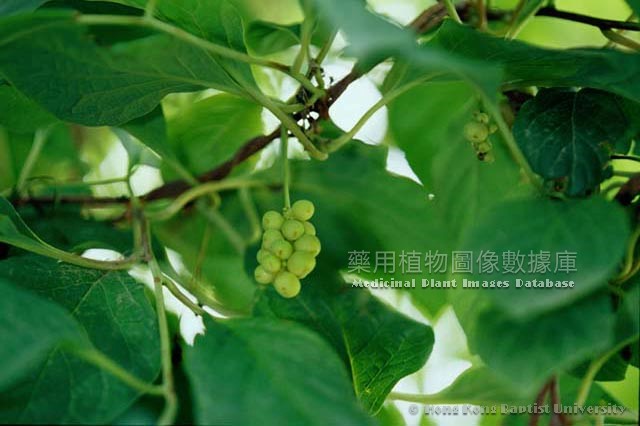
Schisandra sphenanthera Rehd. et E. H. Wils.
|
English Name |
Orange Magnoliavine, Orange Magnolia-vine |
|
Latin name |
Schisandra sphenanthera Rehd. et E. H. Wils. |
|
Family & Genus |
Magnoliaceae, Schisandra |
|
Description |
Deciduous woody vine. Bud scales long ciliate. Leaves papyraceous, obovate, broadly obovate, obovoid long elliptic or rounded, rarely oval, 5-11cm long, apex short and cuspidate or acuminate, base cuneate or broadly cuneate, decurrent to petiole into narrow wings, greyish green below, with white dots, thin veins sparsely covered with fine soft hair, above sparsely grown callose sharp teeth. Flowers grown at branchlets near base axil. Pedicels 2-4.5cm long, base with bracts in length of 3-4mm; tepals 5-9, orange-yellow, approximately oval or oblong obovate, the middle whorl with length 0.6-1.2cm, ciliate, with glandular dots. Male flowers and androecium inverted oval, diameter 4-6mm, apex of receptacle obtuse, stamens 11-19, locule cracks medially, locule tilted, apex separated. Female flowers and gynoecium ovoid, diameter 5-5.5mm, simple pistil 30-60. Small berries red, 0.8-1.2cm long. Seeds oblong or reniform, ca. 4mm long, brown smooth or back rugulose. Flowering: April to July, fruiting: July to September. |
|
Distribution |
Growing on moist hill-slopes or in thickets at altitude 600-3,000m. Distributed in Henan, Shanxi, Shaanxi, Gansu, Jiangsu, Anhui, Zhejiang, Fujian, Jiangxi, Hubei, Hunan, Yunnan, Guizhou and Sichuan. The medicinal materials are mainly produced in Henan, Shaanxi, Gansu; also produced in Sichuan, Yunnan and etc. |
|
Part Used |
Medical part: dried mature fruits. Chinese name: Nanwuweizi. |
|
Harvest & Processing |
Collected when fruits mature in autumn, sundried, removed pedicle and impurities. |
|
Chemistry |
Mainly contains lignan, anwuweizic acid and essential oils. |
|
Pharmacology |
Antitussive, phlegm-eliminating, cardiotonic, anti-hepatic injuries, liver-metabolic-enzymes inducing, antioxidative, anti-ulcerative, anti-renal disorder, anti-bacterial and anti-bacterial; toxic. |
|
Properties & Actions |
Sour, sweet, warm.Inducing astringency, benefiting qi-flow engendering liquid, tonifying kidney and calming the heart. |
|
Indications & Usage |
Lingering cough and dyspnea due to deficiency, nocturnal emissions and spermatorrhoea, anischuria and urinary frequency, lingering diarrhea, spontaneous perspiration, night sweat, hydrodipsia due to depletion of body fluids, shortness of breath and feeble pulse, feverish dysphoria and diabetes, palpitation and insomnia.Oral administration: decocting, 3-6g; powdered, 1-3g; prepared ointment; or made as pills or powders. External application: appropriate amount, powdered; or decocted for washing. |
|
Examples |
1. Treat pulmonary asthenic cold: Chinese magnoliavine fruit, harvest when red and mature, steam, grind and filter, remove seeds, stew to loose paste. Add honey when acid and sweet, steam on fire, stand by till cold, store in a container. Make soup, and swallow at times.
2. Treat cough with dyspnea: Chinese magnoliavine fruit, alumbre of equal amount. Grind into powder. Take 3 qian each time, stir fry with pig lung, and chew and swallow with plain soup.
3. Treat infantile and severe cough: Chinese magnoliavine fruit, laurel (remove coarse peel), dry ginger (prepared) of equal amount. For the above three drugs, coarsely pestle and sieve. Take 1 qian each time, decoct in 7 fen water and concentrate to 4 fen, remove residues, add or decrease the amount appropriately, warm up and swallow. |
| Link to |
 Chinese Medicinal Material Images Database
Phytochemical Image Database
Chinese Medicine Specimen Database Chinese Medicinal Material Images Database
Phytochemical Image Database
Chinese Medicine Specimen Database
|
|


