|
Spiranthes sinensis (Pers.) Ames
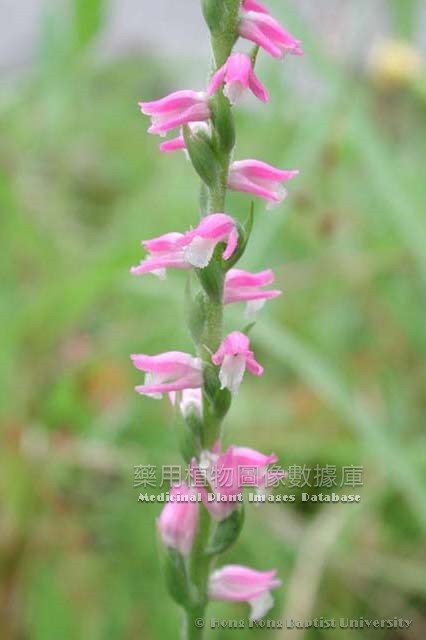
|
English Name |
Ladies Tresses, |
|
Latin name |
Spiranthes sinensis (Pers.) Ames |
|
Family & Genus |
Orchidaceae, Spiranthes |
|
Description |
Plant height up to 30cm. Carnose root. Near the base of stem 2-5 leaves. Leaves broad or wide linear-lanceolate, rarely narrow oblong, extended straight, 3-10cm long, 0.5-1cm wide, base with a stalk-shaped sheath amplexicaul. Flower stems up to 25cm, the upper part glandular pilose or glabrous; inflorescence terminal densely multiflorous, 4-10cm long, spirally twisted. Bracts ovate-lanceolate; ovary fusiform, twisted, glandular pilose or glabrous. Length plus pedicel 4-5mm; flowers purplish red, pink or white, spirally grown in an arrangement of rows in rachis; lower part of sepals connivent, middle sepal narrowly long and rounded, navicular, length 4mm, width 1.5mm, connivent with petals to be cucullate, lateral sepals obliquely lanceolate, 5mm long; petals obliquely rhombic, long and rounded, equal in length to sepals, thinner; labellum broadly long and rounded, concave, length 4mm, hirsute above the anterior half, margin with crisped biting teeth, base of labellum shallowly saccate, with 2 corpus callosum inside capsula. Flowering: July to August. |
|
Distribution |
Growing in mountain forests, thickets, on grasslands or river beaches, in marsh and meadow. Distributed in Heilongjiang, Jilin, Liaoning, Inner Mongolia, Hebei, Shandong, Jiangsu, Anhui, Zhejiang, Taiwan, Jiangxi, Hubei, Hunan, Guangdong, Hong Kong, Hainan, Guangxi, Guizhou, Sichuan, Yunnan, Tibet, Qinghai, Ningxia, Shaanxi, Shanxi and Henan. Also distributed in Russia, Mongolia, Korean Peninsula, Japan, Afghanistan, Kashmir, the Kingdom of Bhutan, India, Burma, Vietnam, Thailand, Philippines, Malaysia and Australia. The medicinal materials are produced in Yunnan, Sichuan, Zhejiang, Hunan, Jiangxi, Henan and etc. |
|
Part Used |
Medical part: roots and entire plant. Chinese name: Panlongshen. |
|
Harvest & Processing |
Collected in summer and autumn, used fresh or sundried. |
|
Chemistry |
Contains dihydroxyphenanthrenes, steroids, and oryzanolum, etc. |
|
Pharmacology |
Anti-tumor. |
|
Properties & Actions |
Sweet, bitter, neutral.Reinforcing qi, tonifying yin, clearing heat and detoxifying. |
|
Indications & Usage |
Weakness after diseases, yin asthenia which generates intrinsic heat, coughing and hematemesis, dizziness, relative weakness and lumbago, diabetes, emissions, whitish and turbid urine, leukorrhea, swelling pain in the throat, venomous snake bites, scalding and burns, furuncles and ulcers.Oral administration: decocting, 9-15g; entire fresh plant 15-30g. External application: appropriate amount, fresh herb triturated for application. |
|
Examples |
1. Treat asthenia after diseases: Chinese ladiestresses root, angelica 9g each, milkvetch 15g. Decoct in water and swallow.
2. Treat tuberculosis, asthenic fever, coughing up blood: Chinese ladiestresses root 15g, fritillary 9g. Decoct in water and swallow.
3. Treat neurastheria: Ladies Tresses 12g, thinleaf milkwort 9g, silk-tree 15g. Decoct in water and swallow.
4. Treat dizziness and asthenia: elecampane. Grind 3g into powder, and swallow with oily soup.
5. Treat lumbago, emissions, leucorrhea: Chinese ladiestresses root, black sesame 30g each, black soybean, malaytea scurfpea, Chinese yam, raspberry, cherokee rose 15g each. Stir-fry beans, grind into a powder, and prepare into honey pills. Take 9g each time in the morning and night with boiled water. |
|


