|
|
|
Dichroa febrifuga Lour.
|
English Name |
Antifebrile Dichroa, |
|
Latin name |
Dichroa febrifuga Lour. |
|
Family & Genus |
Saxifragaceae, Dichroa |
|
Description |
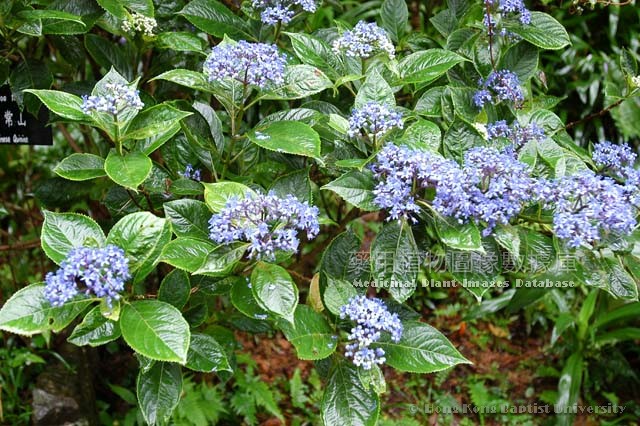
Deciduous shrubs, 1-2m tall. Taproot wooden, cylindrical, often curved, more than 30cm long, skin yellow-brown or grey-brown. Stem round, with prominent nodes, with brown short hairs when young. Branchlets green, glabrous, or sparsely pubescent. Leaves opposite; with petioles, petioles 1-2cm long; shape of leaves changed, leaves oval, broad lanceolate or long round obovate, rarely lanceolate, upper part dark green, margin serrated, sparsely brown short hairy on both sides when young, apex acuminate, base cuneate, upper part of midrib sunken. Cyme cone-shaped, borne in the top of branches or upper axils, flowers blue or cyanic; peduncles about 2cm long, densely brown short hairy; bracts linear-lanceolate, caducous, small pedicels 3-5mm long; calyx inverted cone-shaped, light blue, about 4mm long, apex 4-7 teeth, broad triangle, outside of tube densely brown short hairs; petals 4-7 pieces, nearly succulent, blue, oblong-lanceolate or ovate, about 8mm long, about 3mm wide, apex obtuse, base truncate, folds down after unfolding; stamens 10-20 pieces, half opposite with petals, borne in the base of petals, filaments flat, 2-6mm long, anthers blue, oblong, 2 chambers longitudinal lobed; ovary inferior, blue, oblong, 1 chamber, ovules many, style 5, about 2mm long, stigma elliptic. Berries blue, circular, 3-7mm in diameter, black when dried, with persistent calyx and style, most of seeds reticulate. Flowering: June to July, fruiting: August to September. |
|
Distribution |
Growing in dank places of forests. Or cultivated under forests. Distributed in Gansu, Jiangxi, Hubei, Hunan, Anhui, Jiangsu, Shaanxi, Sichuan, Guizhou, Yunnan, Guangdong, Guangxi, Fujian and etc. The medicinal materials are mainly produced in Sichuan and Guizhou. |
|
Part Used |
Medical part: roots. Chinese name: Changshan. |
|
Harvest & Processing |
Excavated in autumn; removed fibrous roots, washed, and sun-dried. |
|
Chemistry |
Roots mainly contain alkaloids: orixine, isofebrifuzine and dichroine, etc. |
|
Pharmacology |
Resistant to amoeba, anti-malaria, emetic, antifebrile, antivirotic and anticancer. |
|
Properties & Actions |
Bitter pungent, cold; toxic.Preventing malaria attack and dissolving phlegm. |
|
Indications & Usage |
Malaria.Oral administration: decocting 5-9g; or made as pills or powders. |
|
Examples |
1. Warm malaria with no appetite. anemarrhena, turtle shell (stir fried), antifebrile dichroa 2 liang each, lycium bark 3 liang (cut into pieces), bamboo leaves 1 sheng (cut into pieces), cypsum fibrosum 4 liang. Decoct in 7 sheng and allow to concentrate to 2.5 sheng. Warm up and swallow in 3 sips. Avoid garlic, hot noodles, pig and fish.
2. Excess phlegm in thoracic cavity, headache, loss of appetite and drinking: antifebrile dichroa 4 liang, ural licorice 0.5 liang. Decoct in 7 sheng and concentrate down to 3 sheng, add 0.5 sheng honey and swallow 1 sheng. Take drug again if vomiting is not induced. Honey can be added or not.
3. Patients with lingering malaria. antifebrile dichroa 3 liang, turtle shell 1 liang (stir fried), skunk bugbane 1 liang, aconite root 1 liang, cuttebone 1 liang. Immerse in 6 sheng liquor, take close to fire for one night. Swallow 1 he, and several times before onset of disease. |
| Link to |
 Chinese Medicinal Material Images Database
Chinese Medicine Specimen Database Chinese Medicinal Material Images Database
Chinese Medicine Specimen Database
|
|
Permanent URL:https://sys01.lib.hkbu.edu.hk/cmed/mpid/detail.php?herb_id=D00466 |
|
|
|


