|
Stemona japonica (Bl.) Miq.
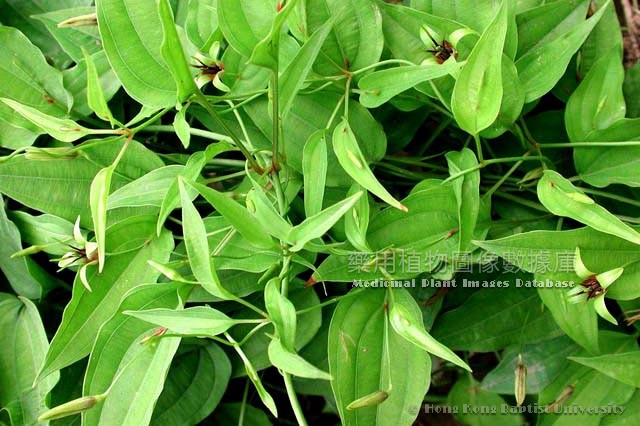
|
Latin name |
Stemona japonica (Bl.) Miq. |
|
Family & Genus |
Stemonaceae, Stemona |
|
Description |
Tuberous root carnose, clustering, often long and rounded, fusiform, thickness 1-1.5cm. Stems up to about 1m, often with few branches, lower erect, upper climbing. Leaves 2-4 whorled, papyraceous or thinly coriaceous, ovate, ovate-lanceolate or ovate-oblong, length 4-9cm, width 1.5-4.5cm, apex acuminate or acute, margin sinuolate, base rounded or truncate, rarely shallowly cordate and cuneate; primary veins usually 5, sometimes up to 9, both surfaces intumescent, transverse veins dense and parallel; petiole slender, 1-4cm long; peduncle adnate to midrib of leaf blade, flowers solitary or several flowers arranged into cymose inflorescences, flower stalk slender, 0.5-4cm long; bracts linear-lanceolate, ca. 3mm long; tepals light green, lanceolate, length 1-1.5cm, width 2-3mm, apex acuminate, base wider, with 5-9 veins, reflexed after blooming; stamens purplish red shorter than or equal in length to perianth; filaments short, ca. 1mm long, base connates into ring more or less; anthers linear, ca. 2.5mm long, apex of anthers with one arrow-shaped appendage, both sides with an erect or pendulous filament; connectives erect, extending to be subulate or linear appendage; capsule ovoid, flattened, reddish brown, 1-1.4cm long, 4-8mm wide, apex acute, 2 croccus dehiscent in mature fruit, often with 2 seeds. Seeds ellipsoid, slightly flattened, ca. 6mm long, 3-4mm wide, deep purplish brown, surface with longitudinal sculcus stripes, one end clustered with numerous yellowish, membranous short rod-shaped appendage. Flowering: May to July, fruiting: July to October. |
|
Distribution |
Growing in tussock, on roadsides and in forests at altitude 300-400m. Distributed in Zhejiang, Jiangsu, Anhui, Jiangxi and etc. The medicinal materials are produced in Zhejiang. Also produced in Anhui and Jiangsu. |
|
Part Used |
Medical part: dried earthnut. Chinese name: Baibu. |
|
Harvest & Processing |
Excavated in spring and autumn, removed fibrous root, well washed, heated in boiling water or steamed until no white in the center, taken out, and sun-dried. |
|
Chemistry |
Mainly contains stemonine, tuberostemonine, and tuberostemonone, etc. |
|
Pharmacology |
Anti-pathogenic microorganism, anti-parasites, insects-killing, cough-checking, phlegm-removing, pant-calming and central-nervous-system-inhibiting; toxic. |
|
Properties & Actions |
Sweet, bitter, little warm.Moistening lung, keeping the adverse qi flowing downward, checking cough and killing parasites. |
|
Indications & Usage |
Lingering cough, coughing due to tuberculosis, whooping cough, externally applied to take care of head lice, body lice, enterobiasis, prurius vulvae.Oral administration: decocting, 3-10g. External application: prepared decoction for washing; or powdered for application; or made as medicinal liquor for application. |
|
Examples |
1. Treat cough: fresh ginger juice, stemona juice, mix and decoct, take 2 he.
2. Treat cough lingering for 30 years: stemona root 20 jin. Pestle and collect juice, decoct to syrup. Swallow a small spoonful 3 times a day.
3. Treat infantile whooping cough: honey fried stemona, common selfheal 9g each. Decoct in water and swallow. |
| Link to |
 Chinese Medicinal Material Images Database Chinese Medicinal Material Images Database
|
|


