|
|
|
Cercis chinensis Bunge
|
English Name |
Chinese Redbud, China Redbud, Chinese Red Bud, China Red Bud |
|
Latin name |
Cercis chinensis Bunge |
|
Family & Genus |
Fabaceae, Cercis |
|
Description |
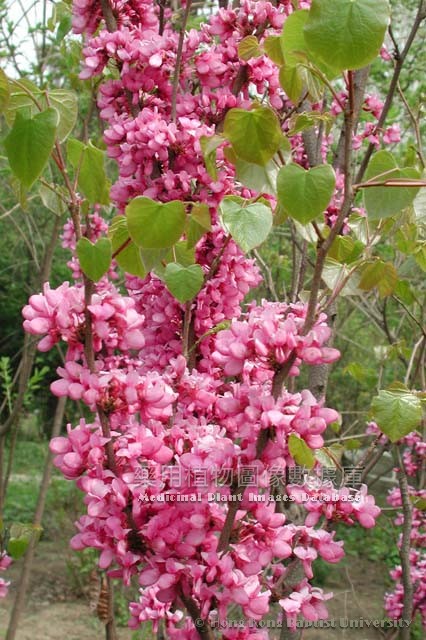
Clustered or solitary shrubs, 2-5m tall. Bark dark grey and smooth when young, rough and sheet-cracked when old. Branchlets grey white. Simple leaves alternate; petioles up to 3cm long; blades papyraceous, nearly round or triangular round, 5-10cm long, 5-10cm wide, apex acute, base shallow to deep heart-shaped, both sides usually glabrous, entire. Flowers open before leaves, 2-10 flowers fascicled, clustered on old branches and trunk; bractlets 2, broad oval, about 2.5mm long; pedicels thin, about 3-9mm long; calyx campanulate, 5 teeth cracked; flowers rose red, about 1-1.3cm long, corolla butterfly-shaped, ranging in size, base of keels with deep purple stripes; stamens 10, separated, filaments slender; pistil 1, ovary tender green, glabrous, with stalks, upper part of style curved, stigma short, flattened, with 6-7 ovules. Pods flat and narrow, green, 4-8cm long, 1-1.2cm wide, wings about 1.5mm wide, apex acute or shortly acuminate, beaks thin and curved, base long acuminate, sutures on both sides symmetrical or nearly symmetrical. Seeds 2-6, broad oblong, 5-6mm long, about 4mm wide, dark brown, shiny. Flowering: April to May, fruiting: May to July. |
|
Distribution |
Growing on roadside of hill-slopes. Can be cultivated. Distributed in North, East, South-central and Southwest China, Shaanxi, Gansu and etc. The medicinal materials are mainly produced in most parts of China. |
|
Part Used |
Medical part: bark and flowers. Chinese name: bark: Zijinpi; flowers: Zijinhua. |
|
Harvest & Processing |
Bark: collected bark from June to July and sun-dried. Flowers: picked from April to May and sun-dried. |
|
Chemistry |
Flowers contain afzelin, quercetin-3-α-L-rhamnoside, and myricetin-3-α-L-rhamnoside, etc. |
|
Pharmacology |
Bark: anti-inflammatory, pain-killing and resistant to pathogenic microorganism. |
|
Properties & Actions |
Bark: bitter, neutral. Flower: bitter, neutral.Bark: quickening the blood, relieving strangury and resolving toxin. Flowers: clearing heat, cooling blood, relieving strangury resolving toxin. |
|
Indications & Usage |
Bark: used for irregular menses, static and stagnant abdominalgia, rheumatic arthralgia, painful stramgutia, pharyngitis, anthracia, sarcoptidosis, injuries caused by falls, bites by snakes and insects. Flower: Used for pyretic stranguria, bloody stranguria, pyocutaneous disease, rheumatic ostalgia.Bark: oral administration: decocting,6-15g; or made as medicinal liquor, pills or powders. External application: appropriate amount, ground and apply mixed. Not use in cases of pregnancies. Flowers: oral administration: decocting, 3-6g; external application: appropriate amount, powdered for application. |
|
Examples |
Bark:
Post partum stranguria: Chinese redbud peel 15g. Decoct in half liquor and half water, warm up and swallow.
Flower:
Primary lesions in nose: Chinese redbud flower dried at a place away from light, grind into a powder and paste. |
|
Permanent URL:https://sys01.lib.hkbu.edu.hk/cmed/mpid/detail.php?herb_id=D00555 |
|
|
|


