|
|
|
Trollius chinensis Bunge
|
English Name |
Chinese Globeflower , China Globeflower, Chinese Globe flower, Chinese Bog Trollius |
|
Latin name |
Trollius chinensis Bunge |
|
Family & Genus |
Ranunculaceae, Trollius |
|
Description |
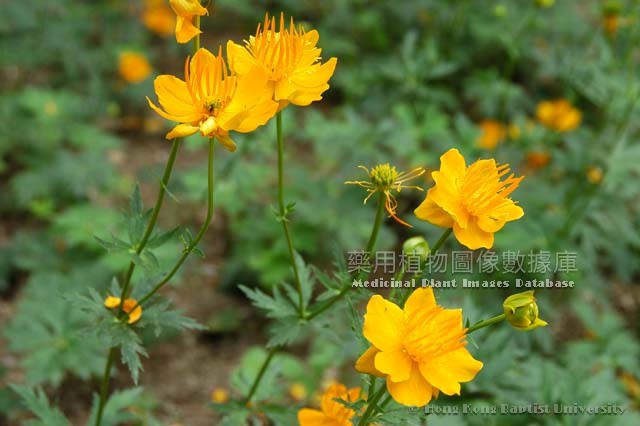
Perennial herb, 30-70cm high. Whole plant hairless. Stem upright, unbranched, sparsely grown 2-4 leaves, fleshy, hollow, light greyish green. Basal leaf 1-4, 16-36cm long, with long stipe, stipe 12-30cm long, with narrow sheath in basal part; lamina quinquangular, 3.8-6.8cm long, 6.8-12.5cm wide, 3 entirely lobed, central entire lobe rhombus, tip suddenly pointed, 3 lobes reaching middle part or slightly exceeding middle part, margin with unequal triangular sharp sawtooth in size; lateral entire lobes fan shaped, 2 deep lobes near basal part, deep lobes upside similar to central entire lobes, deep lobes downside comparatively small, oblique rhombus; stem leaf alternate, leaf similar to basal leaf in shape, leaf in the lower part of stem with long stipe, leaf gradually becomes smaller upward, with short stipe or sessile. Flower bisexual, single flower basidixed or 2-3 flower arraged into a sparse cyme, 3.8-5.5cm in diameter; peduncle 5-9cm long; bract 3 lobed; sepals generally 8-15, 1.5-2.8cm long, 7-16mm wide, elliptic ovate or invert ovate, golden yellow, not turning green when dried, tip sparsely grown with triangular tooth, occasionally with 3 lobelets, or with indistinct toothlets; petals plentiful, about 18-21, narrow linear, slightly longer than or equal to sepal in length, 1.8-2.2cm long, 1.2-1.5mm wide, apex gradually pointed, with a nectary near basal part; stamens plentiful, 5-11mm long, in sprial arrangement, filament linear, anther lobed laterally, 3-4mm long; carpel 20-30. Follicle, 1-1.2cm long, about 3mm wide, with net vein, rostellum about 1mm long. Flowering: June to July; fruiting: August to September. |
|
Distribution |
Growing on grassy slopes or under thin forests at altitude 1,000-2,200m. Distributed in Henan, Hebei, Shanxi, South Inner Mongolia, Northeast China and etc. The medicinal materials are mainly produced in Henan, Hebei, Shanxi, South Inner Mongolia, Northeast China and etc. |
|
Part Used |
Medical part: flowers. Chinese name: Jinlianhua. |
|
Harvest & Processing |
Collected in summer when flowering and air-dried. |
|
Chemistry |
Flowers contain veratric acid, veratramide, orientin and vitexin, etc. |
|
Pharmacology |
Anti-bacterial and antivirotic. |
|
Properties & Actions |
Bitter, little cold.Clearing heat-toxin, detumescence and improving eyesight. |
|
Indications & Usage |
Cold and pyrexia, sore mouth, swelling pain in the gums, gingival bleeding, swelling pain of throat, swelling pain induced by conjunctival congestion, furunculosis and swelling, acute myringitis, acute lymphangitis, acute conjunctivitis.Oral administration: decocting, 3-6g, or brewed as tea for drinking. External application: appropriate amount, decocted for mouth rinse. Use with caution in cases of deficient-cold in spleen and stomach. |
|
Examples |
Acute and chronic tonsillitis: Chinese globeflower 6g, mongolian dandelion 15g, infuse with boiling water, drink as tea, hold the medicine inside the mouth and gargle. |
|
Permanent URL:https://sys01.lib.hkbu.edu.hk/cmed/mpid/detail.php?herb_id=D00644 |
|
|
|


