|
Euryale ferox Salisb. et Koenig et Sims
|
English Name |
Gordon Euryale, Stachelige Euryale |
|
Latin name |
Euryale ferox Salisb. et Koenig et Sims |
|
Family & Genus |
Nymphaeaceae, Euryale |
|
Description |
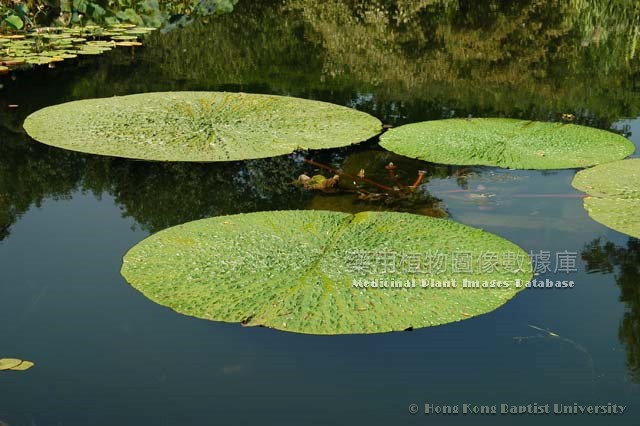
Annual large sized hydrophilous herb. Whole plant with pointed spines. Rhizome thick, strong and short, with white fibrils and indistinct stem. Initial leaf submerged, arrow shaped or elliptic kidney shaped, 4-10cm long, both sides stingless; leaf stingless; metaphyll floating on water surface, elliptic kidney shaped to round, peltate, entire, 10-130cm in diameter, coriaceous, upper surface deep green, with many wrinkles, lower surface deep purple, covered by short soft hairs, leaf vein raised, margin folded upward. Petiole and peduncle thick and strong, up to 25cm long, with hard spines. Flower solitary, open at day time, close at night, about 5cm long; sepal 4, lanceolate, 1-1.5cm long, inner surface purple, exteriorly grown with hard spines; petal plentiful, long circular lanceolate or lanceolate, 1.5-2cm long, purplish red, arranged in several whorls; stamen plentiful; ovary inferior, carpel 8, stigma red, forming a incurvate round disc, flat. Berry spherical, 3-5cm in diameter, spongeous, dark purplish red, exteriorly grown with hard spines. Seed spherical, about 10mm in diameter, black. Flowering in July to August, fruiting in August to September. |
|
Distribution |
Growing in paddy fields or ponds. Distributed in provinces in central and southern parts of China. The medicinal materials are mainly produced in Jiangsu, Shandong, Anhui, Hunan, Hubei and etc. |
|
Part Used |
Medical part: roots, leaves, anthocaulus and kernel. Chinese name: roots: Qianshigen. Leaves: Qianshiye. Anthocaulus: Qianshijing. Kernel: Qianshi. |
|
Harvest & Processing |
Roots: harvested from Sept-Oct, and sun-dried. Leaves: harvested in June-August, and sun-dried. Anthocaulus: harvested from July to September, and sun-dried. Kernel: harvested when fruits mature from Sept-Oct and dried in the shade. |
|
Chemistry |
Roots: contain sterols, such as 24-methylcholest-5-enyl-3β-O-pyranoglucoside and daucoste-rol, etc. Kernel contains starch, protein, and fat, etc. |
|
Properties & Actions |
Root: salt, sweet, neutral. Leaves: bitter, sweet, neutral. Flower stem: salt, sweet, neutral. Seed nut: sweet, harsh, neutral.Roots: dissipating binds for suppressing pains and stopping leukorrhagia. Leaves: promoting qi-flowing and harmonizing the blood, dispelling stasis and relieving hemorrhage. Anthocaulus: clearing deficient-heat, engendering liquid. Kernel: securing the kidney and astringing essence and nourishing spleen for stopping diarrhea. |
|
Indications & Usage |
Root: hernia pain, unknown pyogenic infections, leucorrhea, Leaves: hematemesis, hemafecia. Scape: thirst due to asthenic fever, dry mouth and throat. Kernel: emissions, stranguria with turbid urine, whitish and turbid urine, dripping urine, leukorrhea, loose stools.Roots: oral administration: decocting, 30-60g; or cooked. External application: smashed for applying. Leaves: oral administration: decocting, 9-15g; or burnt preserving nature, powdered, administered after dissolved. Anthocaulus: oral administration: decocting, 15-30g. Kernel: oral administration: decocting, 15-30g; or made as pills or powders. Use with caution in cases of food detention; not use in those with adverse urine. |
|
Examples |
1. Leucorrhea, splenic and renal deficiency, whitish and turbid urine: gordon euryale fruit 250g, stew with chicken and eat.
2. Promoting afterbirth and stopping hemorrhage: gordon euryale fruit leaf 1 piece, burn ash swallow with boiled water or mix with liquor and swallow. |
| Link to |
 Chinese Medicinal Material Images Database
Chinese Medicine Specimen Database Chinese Medicinal Material Images Database
Chinese Medicine Specimen Database
|
|


