|
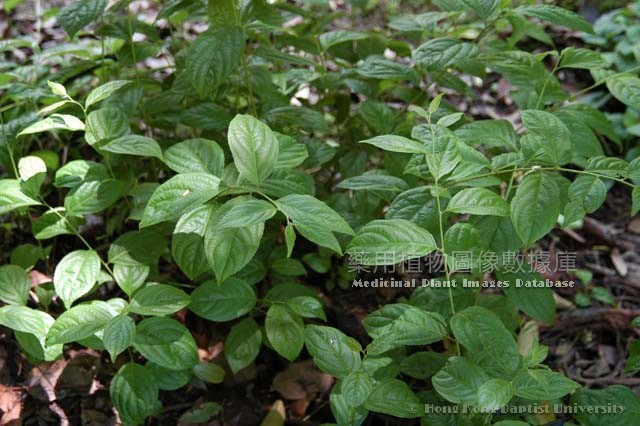
Tripterygium wilfordii Hook . f
|
English Name |
Common Threewingnut, Thundergodvine, Wilford Three-wing-nut, Wilford Three-winged Nut, Bullock Threewingnut |
|
Latin name |
Tripterygium wilfordii Hook . f |
|
Family & Genus |
Celastraceae, Tripterygium |
|
Description |
Deciduous trailing shrub, 1-3m high. Branchlet brownish red, with 4-6 ridges, densely grown with strumose lenticels and rusty short hairs. Simple leaf alternate, sub-coriaceous; lamina elliptic or broad ovate or ovate, 4-9cm long, 3-6cm wide, tip suddenly pointed or short and gradually pointed, basal part nearly round or broad wedge shaped, margin with thin sawtooth, upper surface smooth, lower surface light green, both main vein and lateral vein on upper surface slightly protruding, lateral vein 4-7 pairs, sparsely grown with rusty brown soft hairs on the vein; petiole 5-8mm long, densely grown with rusty short hairs. Cymose panicle basidixed or axillary, 5-7cm long, 3-4cm wide, covered with rusty hairs, generally with 3-5 branches, peduncle 1-2cm long, pedicel up to 4mm long. Flowers hermaphrodite, white, 4-5mm in diameter; calyx with 5 shallow lobes, tip suddenly pointed; petals 5, elliptic; flower disc 5 lobed; stamens 5, inserted in the outer margin of flower disc, filament up to 3mm long, comparatively broad near basal part; style short, columnar, stigma with 3 shallow lobes; Ovary superior, trigonous. Key fruit with 3 pieces of membranous wing, long circular, red, up to 14mm long, about 13mm wide, with inclined lateral vein on the wing. Seed 1, thin-columnar, black, up to 10mm long. Flowering: July to August; fruiting: September to October. |
|
Distribution |
Growing in dank valleys, on hill-slopes and in streamside thickets. Distributed in the south of the Yangtze River and Southwest China. The medicinal materials are mainly produced in Fujian, Jiangsu, Zhejiang, Anhui, Hunan, Guangxi and etc. |
|
Part Used |
Medical part: roots. Chinese name: Leigongteng. |
|
Harvest & Processing |
Collected after 3-4 years of planting, excavated the roots in autumn, removed earth, sun-dried or after removing bark. |
|
Chemistry |
Mainly contains alkaloids, like wilfordine, wilforine and wilforgine, etc, also triterpene, like salaspermic acid and triptotriterpenic, etc. |
|
Pharmacology |
Anti-tumors, anti-fertile, and anti-inflammatory. |
|
Properties & Actions |
Bitter, pungent, cool, very toxic.Dispelling pathogenic wind and removing dampness, promoting blood circulation and freeing meridians, detumescence for suppressing pains, destroying parasites and detoxifying. |
|
Indications & Usage |
Pain of rheumatic joints, rheumatoid arthritis, glomerular nephritis, dropsical nephritis, lupus erythematosus, sicca syndrome, Behcet disease, psoriasis, leprosy, eczema, gaile, refractory tinea.Oral administration: decocting, root xylem without 15-25g; roots with bark 10-12g. both decocted for 1-2 hours by gentle fire, or made as syrups or ointment. For capsule, taken 0.5-1.5g per time, 3 times daily. External application: appropriate amount, powdered or smashed for applying. Use with caution in cases of heart, liver, kidney or leukocyte decrease; Not use in cases of pregnancies. |
|
Examples |
1. Skin pruritus: common threewingnut leaves, pestle, smear externally.
2. Rheumatic arthritis: common threewingnut root, leaves, pestle and apply externally, itching will be dispelled half an hour later, or blister will be induced. |
| Link to |
 Phytochemical Image Database
Chinese Medicine Specimen Database Phytochemical Image Database
Chinese Medicine Specimen Database
|
|


