|
Alocasia macrorrhiza (L.) Schott
|
English Name |
Giant Alocasia, A1ocasia, Hawaiian giant Taro |
|
Latin name |
Alocasia macrorrhiza (L.) Schott |
|
Family & Genus |
Araceae, Alocasia |
|
Description |
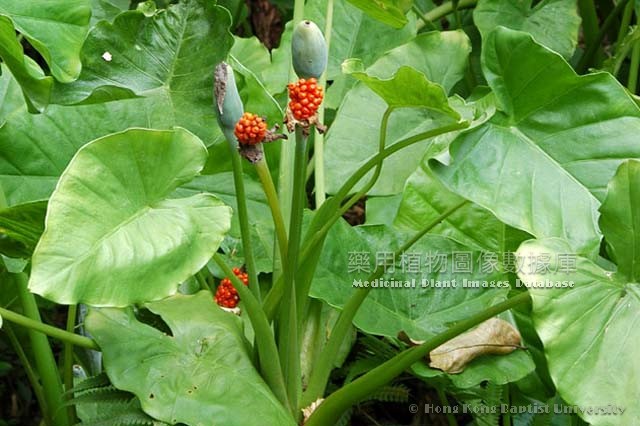
Perennial herbs, up to 5m. Stem stout, stem 30cm thick. Petioles stout, 60-90cm long, lower part thick, amplexicaul: leaves wide ovate, 30-90cm long, 20-60cm wide, apex short acute, base broad cordate-arrow-shaped, lateral veins 9-12 pairs, thick and prominent, green. Flowers hermaphrodite; rachis stout, 15-20cm long; tubes of spathes 3-4cm long, pink-green, bracts navicular, 10-14cm long, 4-5cm wide, green-yellow, apex acute; spadixes shorter than spathes; female inflorescences 2-2.5cm long, located in lower part; neutral inflorescences 2.5-3.5cm long, located on female inflorescences; male inflorescences 3cm, located on neutral inflorescences; adnexal ca. 3cm long, with reticular grooves; ovary 3-4-chambered. Berry red. Seeds 1-2. Flowering: spring to autumn. |
|
Distribution |
Growing in mountainous areas at altitude below 1,700m. Distributed in South, Southwest China, Fujian, Taiwan, Hunan and etc. The medicinal materials are mainly produced in Guangdong and Yunnan. |
|
Part Used |
Medical part: rhizomes or stem. Chinese name: Haiyu. |
|
Harvest & Processing |
Harvested throughout the year, chip off cortex, sliced and bleach in water for 5-7 days, and change water several times, taken out for fresh use or sun-dried it. Mat hand when processing in case of getting poisoned. |
|
Chemistry |
Mainly contains vitamins: B1 (thiamin), B2(riboflavin), and nicotinic acid. Sterols: cholesterol, stigmasterol; esters: glycolipids, phospholipids; fat: linoleic acid and linolenic acid. |
|
Pharmacology |
Antipyretic and anti-tumor. |
|
Properties & Actions |
Pungent, cold, toxic.Clearing heat-toxin, promoting qi-flowing for suppressing pains, dissipating binds for detumescence. |
|
Indications & Usage |
Influenza, common colds, stomachache, pulmonary tuberculosis, rheumatic ostalgia, sores, superficial infection, toxic swelling and scrofula.Oral administration: decocting, 3-9g, fresh products 15-30g (sliced and made brown by stir-heating with rice, boiled till rice get mushy, used by removing residue or used after decocting as long as 2 hours). External application: appropriate amount, smashed for application (not on health skin); or prepared paste; or heated for applying. Toxic, not raw eaten, Not use in cases of physically weak or pregnancies. |
|
Examples |
1. Headache and fatigue due to common cold: (wild) Giant Alocasia root wrapped with damp paper, roast, rove on head, forehead, waist and spine, front and back of heart, bends of arm and leg. It can make Your body comfortable.
2. Rheumatic osteodynia: thick slice of wild Giant Alocasia. First place a little camphor onto the center of taro, roast camphor with fire, and apply to lesions when the fire tends to extinguish.
3. Anthracia and sore and furuncle: (wild taro) an appropriate amount of fresh root. Add 30g alcohol, pestle, wrap with (wild taro) leaves, roast hot and apply externaly. |
| Link to |
 Chinese Medicine Specimen Database Chinese Medicine Specimen Database
|
|


