|
Amaranthus retroflexus L.
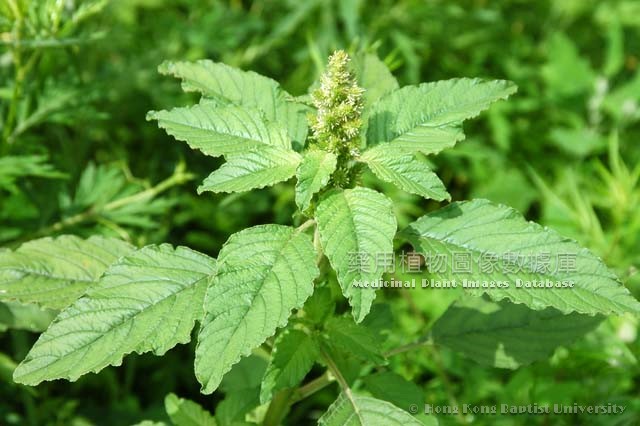
|
English Name |
Redroot Amaranthus, Redroot Amaranth |
|
Latin name |
Amaranthus retroflexus L. |
|
Family & Genus |
Amaranthaceae, Amaranthus |
|
Description |
Annual herbs, 20-80cm tall, sometimes up to more than 1m. Stem erect, stout, single or branched, pale green, sometimes with purple stripes, with slightly blunt edges, densely short hairs. Petioles 1.5-5.5cm long, pubescent. Leaves edge-shape ovate or elliptic ovate, 5-12cm long, 2-5cm wide, apex acute or sharp protruding, with small tips, base cuneate, pubescent on both sides and margin; flowers unisexual or polygamous, together to acrogenous and axillary panicles; tepals 5, white, with one pale green middle vein; stamens of male flowers slightly longer than tepals; female stigma 3, medial with small teeth. Utricles flatly spherical, small, pale green, split by the top cover, wrapped in persistent tepals. Seeds nearly spherical, diameter 1mm, brown or black, margin blunt. Flowering: July –August, fruiting: August to September. |
|
Distribution |
Growing on open fields, farmlands or grassland near villages. Distributed in Northeast, North and Northwest China, Shandong, Taiwan, Henan and etc. |
|
Part Used |
Medical part: whole plant, seeds and roots. Chinese name: whole plant or roots: Yexiancai. Seeds: Yexianzi. |
|
Harvest & Processing |
Entire plant or root: collected in spring, summer, autumn, well washed and used fresh. Seeds: collected fruits in autumn, sundried, rub and taken the seeds and dried. |
|
Chemistry |
Whole plant contains linolenis acid, palmitic acid, linoleic acid, oleic acid and stearic acid) myristic acid, etc. Leaves mainly contain glutamic acid, aspartic acid, methionine, histidine, glucosamine and galactosamine, etc. Seeds mainly contain myristic acid, palmitic acid, stearic acid, arachidic acid, behenic acid, oleic acid and linoleic acid. |
|
Properties & Actions |
Whole plant or root: sweet, little cold. Seeds: sweet, cool.Whole plant or roots: clearing heat-toxin and disinhibiting urine. Seeds: removing liver fire for improving eyesight and disinhibiting urine. |
|
Indications & Usage |
Whole grass or root: dysentery, diarrhea, furunculosis and swelling, venomous snake bites, bee stings, difficulty in urination, edema. Seeds: conjunctival congestion due to hepatic heat, nephelium and cataract, difficulty in urination.Whole plant or roots: oral administration: decocting, 9-30g; smashed to extract juice. External application: appropriate amount, smashed for application. Seeds: oral administration: decocting, 6-12g. |
|
Examples |
1. Ophthalmalgia due to wind-heat: amaranthus seeds 9g, common chrysanthemum 15g, rough gentian 9g, decoct in water and swallow.
2. Swelling pain of hemorrhoids: fresh three-coloured amaranth root 30-60g, large intestine of pig 1 piece. Decoct in water and eat before meals. |
|


