|
Acanthopanax trifoliatus (L.) Merr.
|
English Name |
Trifoliate Acanthopanax, Three-leaved Acanthopanax |
|
Latin name |
Acanthopanax trifoliatus (L.) Merr. |
|
Family & Genus |
Araliaceae, Acanthopanax |
|
Description |
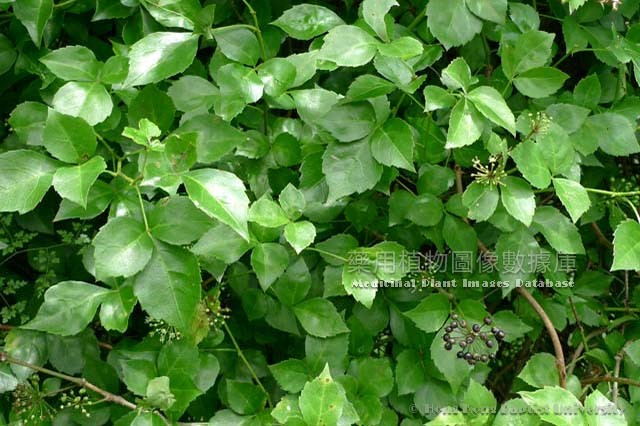
Climber like shrubs, 1-7m tall; branches delicate and spread out, usually rising but depend on others, old branches grey, young branches pale brown, sparsely covered with downward prickles; prickles base flat, apex hooked bent. Leaves alternate, leaflets 3, rare 4-5; petioles 2-6cm, with prickles or no prickles, glabrous; leaflets papery, rarely membranous, ellipse-ovate to ellipse-oblong, rare obovate, 4-10cm long, 3-6.5cm wide, apex acute to acuminate, base cuneate, leaflets base oblique on both sides, glabrous on both sides, or above sparsely bristled on veins, margin with serrulate or blunt serrate, lateral veins 5-6 pairs, apparent or not apparent, venation not apparent; leaflet petioles 2-8mm, sometimes nearly no petioles. Cymes 3-10, rare up to 20 formed acrogenous umbels or panicles, 1.5-3.5cm in diameter; peduncles 2-7cm, glabrous; pedicels slender, 1-2cm long, glabrous; flowers yellow-green; calyx ca. 1.5mm, glabrous, calyx tube margin with 5 small teeth; petals 5, triangular-ovate, ca. 2mm long, curved when flowering; stamens 5, filaments ca. 3mm; ovary 2-chambered, styles 2, base or middle part below connate. Drupe berry-like, flatly spherical, ca. 5mm in diameter, black when mature. Flowering: August to November, fruiting: September to December. |
|
Distribution |
Growing in villages, on roadside on slops, forest edges and thickets, vertically above sea level up to 3,200m. Distributed in South-central and Southwest China. |
|
Part Used |
Medical part: roots, root barks, fowers and twigs. Chinese name: roots or root barks: Sanjiapi. Twigs: Bailezhiye. Flowers: Sanjiahua. |
|
Harvest & Processing |
Roots: excavated in Sep-Oct, used fresh or picked off root bark when fresh and sun-dried. Tender branches and leaves: harvested throughout the year. Fresh used o sun-dried. Flowers: harvested from June to Nov, well washed and used fresh. |
|
Chemistry |
Roots and leaves contain: [3α, 11α-dihydroxylup-20(29)-en-28-oic acid], β-sitosterol, triacontanol, dotriacontanol and hentriacontane, etc. Stems mainly contain fatty acid, n-pentadecanoic acid, palmitic acid, margaric acid, stearic acid and arachidic acid, etc. |
|
Properties & Actions |
Root: bitter, pungent, cool. Twiggery leaves: bitter, pungent, little cold.Roots: clearing heat-toxin, dispersing wind and dampness, quickening blood for relaxing sinew. Tender branches and leaves: clearing heat-toxin, quickening blood for detumescence and removing dampness for closing sores. Flowers: detoxicating for closing sores. |
|
Indications & Usage |
Root: cold and pyrexia, pharyngalgia, headache, pain of gastric cavity, diarrhea, dysentery, costalgia, jaundice, rheumatic arthralgia, weakness in loins and legs, fall injuries and fractures, mammary abscess, pyocutaneous disease and swelling, bites by snakes and insects. Tender branches and leaves: cold and pyrexia, cough and chest pain, dysentery, Rheumatic arthralgia, injury from falls, fractures, cuts, ulcerative carbuncle and suppurative infection, sore mouth, eczema, scabies, bites by toxic insects. Flower: dermatitis rhus.Roots: oral administration: decocting, 15-30g; large amount up to 60g; or made as medicinal liquor; external application: appropriate amount, in powdered or smashed form or prepared decoction for washing. Use with caution in case of pregnancy. Tender branches and leaves: oral administration: decocting, 9-30g; or infused in boiled water. External application: appropriate amount, prepared decoction for washing, or applied in smashed form. |
|
Examples |
1. Cold and pyrexia: Sanjiapi root 15-60g. Decoct in water for oral dose.
2. Cough and asthma: cisanjia root 15g, Korean raspberry root 15g, sunflowerchuxin 15g, decoct and swallow.
3. Measles combined pneumonia: trifoliate acanthopanax root, qingtongmu, dwarf lilyturf, white mulberry root bark, 6g each, kudzu root 6g. Decoct in water for oral dose.
4. Rheumatic arthralgia: trifoliate acanthopanax flower root 30-60g. Stew with half alcohol and water, and eat.
5. Eczema: trifoliate acanthopanax root 30g, stew with fat pork and eat; take an appropriate amount of trifoliate acanthopanax root, decoct in water and wash the outside. |
|


