|
|
|
Tamarix chinensis Lour.
|
English Name |
Chinese Tamarisk, Tamarisk, Five-stamen Tamarisk, Juniper Tamarisk, Chinese Tamarix, Salt Cedar |
|
Latin name |
Tamarix chinensis Lour. |
|
Family & Genus |
Tamaricaceae, Tamarix |
|
Description |
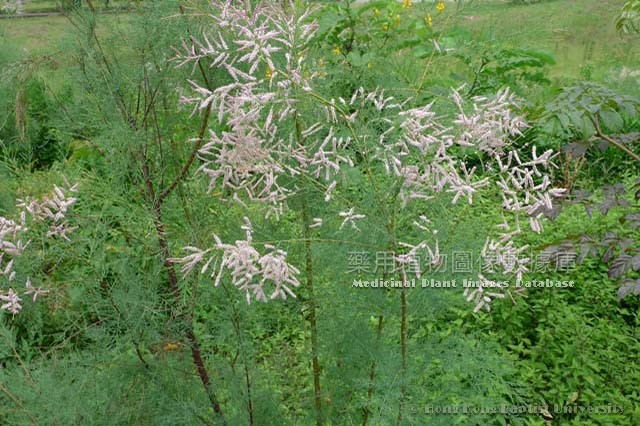
Machaka or dungarunga, 3-6m high. Sprout delicate, stretching and prolapsing, reddish purple or dark purple. Leaf scale like, drill shaped or ovate lanceolate, 1-3mm long, semi-adnate, with keel scaberulous column on the back. Blooming occurs 2-3 times per day; raceme coadnate on the branchlet of previous year's spring, flower slightly big and sparse; forming a basidixed big-sized panicle consisting of racemes on the top of sprout of the year in summer and autumn, usually curled downward, flower slightly small and densely grown, each flower with 1 linear drill shaped green bractlet; flowers 5, pink; sepal ovate; petals elliptic invert ovate, about 2mm long, stamen grown between the lobes of flower disc, longer than petal; ovary cone bottle shaped, styles 3, clavate. Capsule about 3.5mm long, 3 valved. Flowering: April to September, fruiting: June to October. |
|
Distribution |
Growing on river alluvium, coastside, beaches, humid saline-alkali soil and sandy wastelands. Wild in Liaoning, Hebei, Shandong, Jiangsu, Anhui, Henan and etc. Cultivated in the eastern and southwestern parts of China. The medicinal materials are mainly produced in Liaoning, Hebei, Henan, Shandong, Jiangsu, Anhui, Hubei, Guangdong, Fujian, Yunnan and etc. |
|
Part Used |
Medical part: tender branches and leaves. Medical part: Chengliu. |
|
Harvest & Processing |
Collected tender branches before flowering and dried in shade. |
|
Chemistry |
Mainly contains tamari-xinol, tamarixone, tamarixol, β-sitosterol and darcosterol, etc. |
|
Pharmacology |
Cough-checking, hepatic-protective, antibacterial, and antifebrile. |
|
Properties & Actions |
Sweet, pungent, neutral.Removing wind, relieving exterior syndrome, promoting eruption and detoxifying. |
|
Indications & Usage |
Wind-heat type common cold, onset of measles, unrelieved macular eruption, rheumatic arthralgia, skin itching.Oral administration: decocting, 10-15g; or powdered. External application: appropriate amount, prepared decoction for washing. Not use in case of erupted measles and weak health. |
|
Examples |
1. Measles not erupted: Chinese tamarisk, grind into a powder. Decoct 3-4 qian with imperatae rhizoma, or swallow with plain water.
2. Common cold, pyrexia, headache: Chinese tamarisk, mint 9g each, catnip 6g, greenbeanyi 9g, fresh ginger 3g. Decoct in water and swallow.
3. Rheumatic arthralgia: Chinese tamarisk, tigen stick root, spatholobus stem 30g each. Decoct in water and swallow. |
|
Permanent URL:https://sys01.lib.hkbu.edu.hk/cmed/mpid/detail.php?herb_id=D00777 |
|
|
|


