|
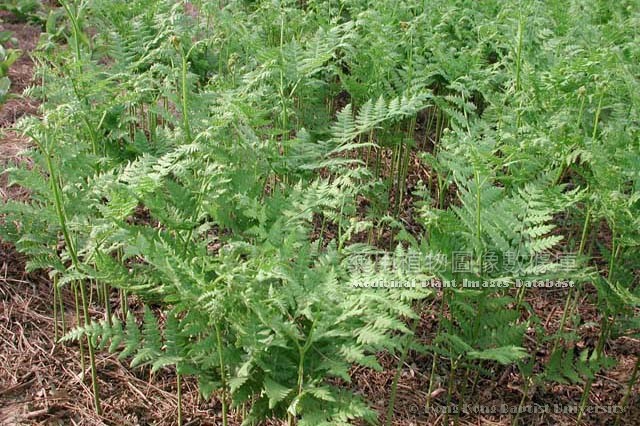
Pteridium aquilinum (L.) Kuhn var.latiusculum (Desv.) Underw.
|
English Name |
Bracken Fern, Eaglefern |
|
Latin name |
Pteridium aquilinum (L.) Kuhn var.latiusculum (Desv.) Underw. |
|
Family & Genus |
Pteridiaceae, Pteridium |
|
Description |
Perennial herb, plants up to 1m high. Rhizome long and transversely extended, stout, covered with dark brown pubescence. Leaf growing far separately; petiole stout, light brown. Smooth, 25-50cm long; leaf blade nearly coriaceous, tripinnatifid to quadripinnatifid, broadly triangular or oblong-triangular, length 30-60cm, width 20-40cm, pinna at the end long and round, apex obtuse, entire or lower part with1-3 pairs shallow or undulate round teeth; lateral veins bifurcate. Sori distributed on the connecting veins at the top of small veins along leaf margin; indusia with shape of lid and bar, being false indusium originated from revolute deformed leaf margin. |
|
Distribution |
Growing in montane forest margins at altitude 200-1,200m, in forest grassland and on sunny hill-slopes. Widely distributed in all parts of China. |
|
Part Used |
Medical part: young leaves and roots. Chinese name: young leaves: Juecai. Roots: Juecaigen. |
|
Harvest & Processing |
Tender leaves: picked in autumn and winter, sun-dried or used fresh. Roots: excavated in autumn and winter, washed, and sun-dried. |
|
Chemistry |
Whole plant contains Pterosin A, B, C, D, E, F, G, I, J, K, L, N, O, Z, acetylpterosin C, benzoylpterosin B, isocrotonylpterosin B and palmitylpterosin A, B, C, etc. |
|
Pharmacology |
Cancerigenic. |
|
Properties & Actions |
Tender leaves: sweet, cold. Root: sweet, cold, toxic.Young leaves: clearing heat for inducing diuresis, downbearing qi-flow dissipating phlegm and relieving hemorrhage. Roots: clearing heat for inducing diuresis, suppressing hyperactive liver and calming mental state, removing toxin for detumescence. |
|
Indications & Usage |
Tender leaves: cold and pyrexia, jaundice, dysentery, leukorrhea, achalasia of cardia, empsyxis due to pulmonary tuberculosis, rheumatic arthralgia. Root: pyrexia, swelling pain in the throat, diarrhea, dysentery, jaundice, leucorrhea, hypertension, dizziness and insomnia, rheumatic arthralgia, hemorrhoids, anal prolapse, eczema, scalding injuries, bites by snakes and insects.Young leaves: oral administration: decocting, 9-15g. External application: appropriate amount, smashed for applying; or powdered for dusting. Not take raw or for long. Use with caution in cases of deficient-cold in spleen and stomach or with scabies. Roots: oral administration: decocting, 9-15g. External application: appropriate amount, powdered or grilled and applied after mixed with fluid. Not take for long and too much. |
|
Examples |
1. Anal prolapse: whole herb of bracken fern 3-6g, decoct, divide into 2-3 parts and swallow.
2. Hypertension, dizziness insomnia: bracken fern 15g. Decoct in water and swallow.
3. Lingering pyrexia: fresh bracken fern root 30-60g. Decoct in water and swallow.
4. Dysentery: fresh bracken fern root, humifuse spurge, plantain 45g each. Decoct in water and swallow. |
|


