|
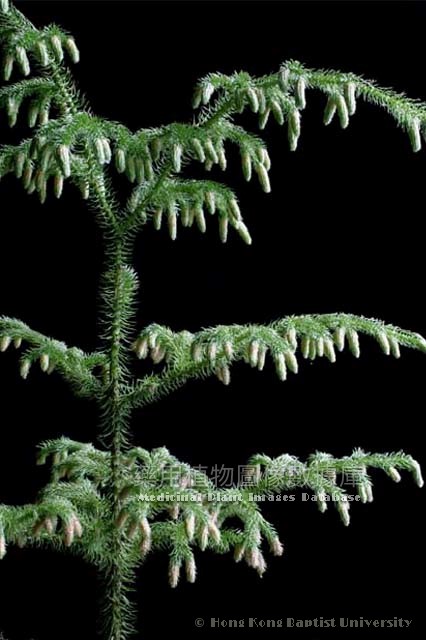
Palhinhaea cernua (L.) Franco et Vase.
|
English Name |
Nodding Clubmoss, |
|
Latin name |
Palhinhaea cernua (L.) Franco et Vase. |
|
Family & Genus |
Lycopodiaceae, Palhinhaea |
|
Description |
Main stem erect, up to 40cm tall, about 2mm in diameter, herbaceous, upper part multi-branched; green, lateral branches extended horizontally, multiple unequally bifurcate-branched, 1-1.5mm in diameter. Leaves dense, spirally arranged, bar-shaped subulate, about 2.5-3.5mm long, 0.2-0.5mm wide, base decurrent and appressed on branchlets, apex slightly incurvate upward, top thorn-shaped, entire, texture thin and soft. Sporangiate spike small, cylindrical, 4-7mm long, 1.5-2.5mm wide, solitary at the top of branchlets, drooping when ripe; sporophyll oval-rhombic, about 1.5mm long, about 0.6mm wide, apex caudate, margin with fimbriate irregular blunt teeth. Sporangium borne in sporophyll axils, round-reniform, light yellow, 0.4mm in diameter. |
|
Distribution |
Growing on acid soil of hills, in broadleaved forest edge and Pinus massoniana forests. Distributed in the south of the Yangtze River. The medicinal materials are mainly produced in the south of the Yangtze River. Mostly self-produced and self-marketing. |
|
Part Used |
Medical part: entire plant and spore. Chinese name: entire plant: Shenjincao. Spore: Shisongzi. |
|
Harvest & Processing |
Entire plant: collected in summer, collected entire plant with root, well washed, and sun-dried. Spore: from July to September, when sporangiums are not mature or uncracked, cut down the spore spikes, sun-dried in waterproof cloth, threshed down the spores and applied after sieving. |
|
Chemistry |
Entire plant contains cernuine, lycocernuine, deoxocernuine, tohogenol and lycernuic acid Aand B, etc. |
|
Pharmacology |
Antifebrile, sedative, smooth-muscle and womb stimulating, the contractility of heart strengthening. |
|
Properties & Actions |
Whole plant: bitter, pungent, neutral. Spore: bitter, warm.Entire plant: removing wind and damp, relaxing muscles, activating blood, checking cough and detoxifying. Spore: astringing dampness, curing sore and checking cough. |
|
Indications & Usage |
Whole herb: pains due to cold and dampness, arthralgia, skin numbness, weakness of four limbs, jaundice, cough, injuries from falls, pyocutaneous disease, herpes, scalding injuries. Spores: skin eczema, summer rash, and cough.Entire plant: oral administration: decocting, 9-15g, or made as medicinal liquor. External application: appropriate amount, triturated for application. Use with care in case of pregnancy and excessive bleeding. Spore: oral administration: made as pills or powders, 3-9g; or made as medicinal liquor. External application: appropriate amount, powdered and scattered. Use with care in case of pregnancy and excessive bleeding. |
|
Examples |
1. Injuries from fall: lycopodii herba 15g, brazilwood, woodlouse 9g, each, false saffron 6g. Decoct in water and swallow.
2. Traumatic hemorrhage: fresh lycopodii herba, pestle and wrap to the affected lesions.
3. Infantile heat rash and skin ulceration in summer: lycopodium seed powder, talcum powder in equal amounts, mix evenly, grind and apply externally. |
|


