|
Aristolochia kwangsiensis Chun et F.C. How ex C.F.Liang
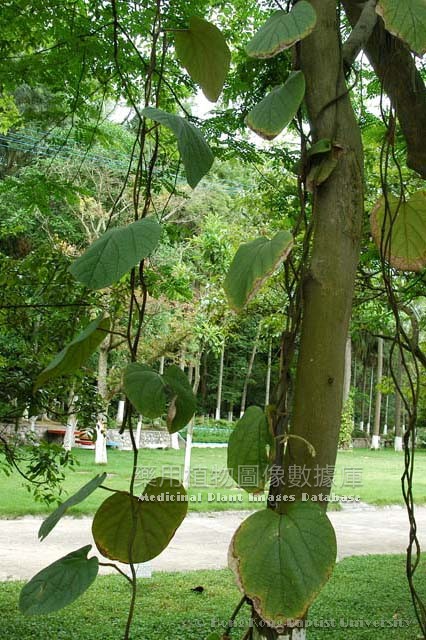
|
English Name |
Guangxi Dutchmanspipe, Guangxi Birthwort, Kwangsi Dutchmanspipe, Kwangsi Dutchman’s-pipe, Guangxi Dutchman’s-pipe |
|
Latin name |
Aristolochia kwangsiensis Chun et F.C. How ex C.F.Liang |
|
Family & Genus |
Aristolochiaceae, Aristolochia |
|
Description |
Herbaceous liane. Tuber elliptic or spindle shaped, usually a number of tubers connected. Young branches with edges, densely dirty yellow or pale brown long seta. Petioles 6-15cm long, densely long seta; leaves thick papery to leathery, ovate-cordate to round, 11-25cm long, 9-22cm wide, apex obtuse or short acute, base wide cordate, side margin entire, sparsely long seta on young leaves, densely dirty yellow or pale brown long seta on both sides of growth leaves, base out 5 veins, prominently bulging below netted veins. Raceme axillary, with 2-3 flowers; peduncles usually downwards bent and droopy, densely dirty yellow or pale brown long seta; bracteoles subulate, densely long seta; middle part of perianth suddenly bent, length of bent position to entablature part and lower part nearly the same and relatively narrow, exterior pale green, with brown longitudinal veins and longitudinal edges, densely pale brown long seta, internal glabrous; entablature part discoidal, blue-purple above and with dark red thorn-shaped protrusions, with netted veins, external densely brown long seta, margin shallow 3 lobed, lobes wide triangular, apex short acute, throat nearly round, yellow, slightly protrudent to collar-shaped; anther pairs adnate to gynostemium, near base; ovary cylindrical, 8-10cm long, with 6 edges; margin of gynostemium lobes downwards and curled, papillae. Capsules dark yellow, long-cylindrical, 8-10cm long, with 6 edges, expanded from apex to lower part crack into 6 upon maturation. Seeds ovate. Flowering: April to May. Fruiting: August to September. |
|
Distribution |
Growing in valley forests. Distributed in Zhejiang, Fujian, Hunan, Guangdong, Guangxi, Sichuan, Guizhou, Yunnan and etc. The medicinal materials are mainly produced in Yunnan, Guizhou, Guangxi and etc. |
|
Part Used |
Medical part: earthnut. Chinese name: Dabaijieshu. |
|
Harvest & Processing |
Excavated in summer and autumn, well washed, used fresh or sliced and sun-dried. |
|
Chemistry |
Roots contain allantoin, aristolochic acid A, β-sitosterol, 6-methoxydenitroaristolochic acid methyl ester, 6-methoxyaristolochic acid A methyl ester and magnoflorine, etc. |
|
Pharmacology |
Pain-killing, spasm-clearing, leukocyt-increasing. |
|
Properties & Actions |
Bitter, cold.Activating qi-flow, relieving pain, clearing heat, detoxifying and arresting bleeding. |
|
Indications & Usage |
Spastic gastralgia, stomachache, acute gastroenteritis, gastric and duodenal ulcer, dysentery, injuries from falls, anthracia and swelling, traumatic hemorrhage, snake bites, bone tuberculosis.Internal: decocting, 6-9g; powdered, 1.5-3g. External: appropriate amount, stir-heated ones powdered and scattered on wounded part; fresh used, triturated for application. |
|
Examples |
1. Ulcerative carbuncle and pyogenic infection: roundleaf dutchmanspipe, fresh rhizome pestled and smeared onto lesions.
2. Acute gastroenteritis, gastric and duodenal ulcer, laryngopharyngitis: roundleaf dutchmanspipe, powder of dried root 0.5-3g, swallow with boiled water.
3. Hypertension: roundleaf dutchmanspipe root 15g, decoct in water and swallow half an hour after meals, 3 times a day. |
|


