|
Andrachne chinensis Bunge
|
English Name |
Chinese Leptopus, Pubescent Chinese Leptopus, Chinese Andrachne |
|
Latin name |
Andrachne chinensis Bunge |
|
Family & Genus |
Euphorbiaceae, Andrachne |
|
Description |
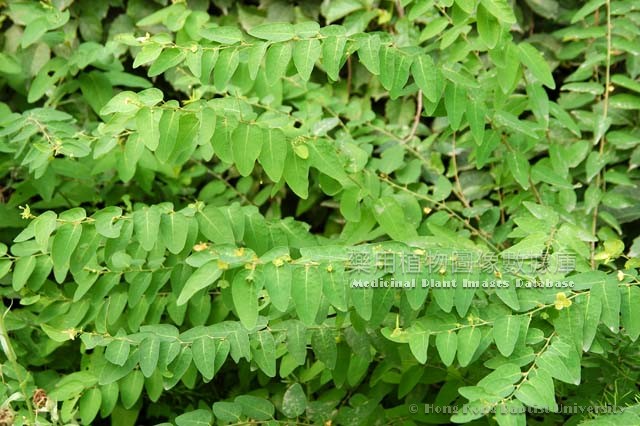
Erect shrubs, up to 3m; upper part of stem and small branches with edges; except branches, leaves, petioles and calyx sparsely short hairs when young, others glabrous. Leaves membranous to thin papery, ovate, nearly round, elliptic or lanceolate, 1-5cm long, 0.4-2.5cm wide, top blunt or acute, base round or wide cuneate, leaf surface dark green, leaf back light green; petioles 2-8mm long; stipules small, ovate-triangular, margin with hairs. Flowers small, hermaphrodite, solitary or 2-4 clustered at axil; calyx, petals and stamens all 5; male flowers pedicels filamentous, anthers ovate; female flowers pedicels 1.5-2.5cm long; petals obovoid; calyx the same as male flowers; flower disc annular, 10 lobed to middle part, lobes oblong; ovary nearly spherical, 3-chambered, each chamber with 2 ovules, styles 3, 2 parted. Capsules round spherical or flat spherical, base with persistent calyx; fruits stalk 2-3cm long. Flowering: February to August; fruiting: June to October. |
|
Distribution |
Growing in mountain thickets, forest edges, on roadsides, rock cliff and crevices of stones. Distributed in most parts of China except in Heilongjiang, Xinjiang, Fujian, Hainan and Guangdong. |
|
Part Used |
Medical part: entire plant. Chinese name: Digouye. |
|
Harvest & Processing |
Harvested in autumn, removed sand and impurities, sun-dried. |
|
Properties & Actions |
Harsh, neutral.Restraining intestine to check diarrhea, slaking thirst and helping produce saliva. |
|
Indications & Usage |
Hydrodipsia and dry pharynx, diarrhea.Internal: decocting, 5-10g. |
|
Permanent URL:https://sys01.lib.hkbu.edu.hk/cmed/mpid/detail.php?herb_id=D00901 |
|
|


