|
Toona sinensis (A.Juss.) Roem.
|
English Name |
Chinese Mahogany, Chinese Toona, China Toona, Chinese Mahogany, Chinese Cedrela, Chinese Cedar |
|
Latin name |
Toona sinensis (A.Juss.) Roem. |
|
Family & Genus |
Meliaceae, Toona |
|
Description |
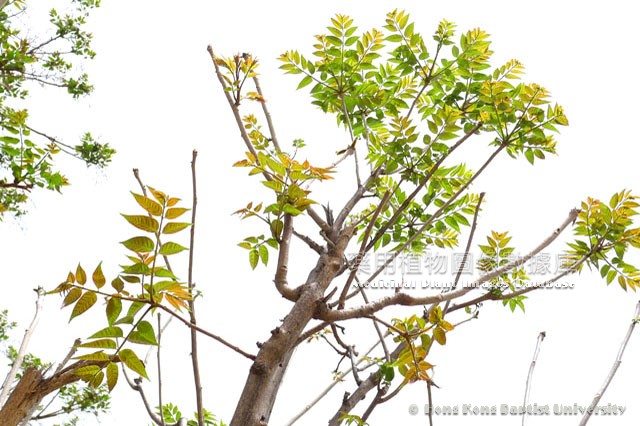
Deciduous tree, up to 16m high. Bark dark brown, exfoliating, branchlet sometime with soft hairs. Biserial pinnate compound leaf alternate, 25-50cm long, with special odour; petiole red, basal part fleshy; leaflets 8-10 pairs, petiolule 5-10mm long; lamina long circular to lanceolate long circular, 8-15cm long, 2-4cm wide, tip sharp, basal part oblique, round or broad wedge shaped, entire or with sparse sawtooth, upper surface deep green, hairless, lower surface light in color, with long bundle-hairs on or between leaf veins, flower small, bisexual, panicle basidixed; flower aromatic; calyx short and small, 5 lobed; petals 5, white, ovate elliptic; staminodium 5, alternate with 5 pieces of developed stamen; ovary superior, with 5 ventricles, flower disc far shorter than ovary. Capsule elliptic or ovate, about 2.5cm long, tip lobed into 5 petals. Seed elliptic, with wings at one end. Flowering: May to June, fruiting: September. |
|
Distribution |
Usually cultivated around houses at altitude below 2,700m, near villages and roadsides. Distributed in North, East, South-central and Southwest China, Taiwan, Tibet and etc. |
|
Part Used |
Medical part: bark and velamen, juice oozing from trunk, leaves, fruits and flowers. Chinese name: bark and velamen: Chunbaipi. Juice: Chunjianyou. Leaves: Chunye. Fruits: Xiangchunzi. Flowers: Xiangchunhua. |
|
Harvest & Processing |
Bark or velamen: can be harvested throughout the year, stripped dried bark, used fresh or sundried; excavated the root, scraped the outer black velamen, beat by mallet to separate the velamen from xylem, sun-dried upturned in case of getting moldy and black, also used fresh. Juice: cut the trunk to ooze out the juice in spring and summer, and sun-dried. Leaves: harvested in spring, mostly used fresh. Fruits: harvested in autumn, and sun-dried. Flowers: picked from May to June, and sun-dried. |
|
Chemistry |
Leaves contain flavonoid compounds, like quercetin-3-O-glucoside, quercetin and quercetin-3-O-rhamnoside, etc.; phenols compounds, like ethyl gallate and gallic acid, etc.; also contain various vitamines and volatile composition. Fruits contain essential oils, like 1-hexanol, anethole and canarele, etc. |
|
Pharmacology |
Isolate-intestinal-canal regulating. |
|
Properties & Actions |
Bark and root peel: bitter, harsh, little cold. Juice: pungent, bitter, warm. Leaves: pungent, bitter, neutral. Fruits: pungent, bitter, warm. Flower: pungent, bitter, warm.Dispelling wind and suppressing cough, invigorating spleen and promoting qi-flowing, disinhibiting dampness and relieving strangury. |
|
Indications & Usage |
Bark and root peel: diarrhea, dysentery, discharging fresh blood stool, metrorrhagia and metrostaxis, leukorrhea, ascariasis, filariasis, sores and acariasis. Juice: snoring, rhagadia manus et pedis, furunculosis. Leaves: acu-injury of diaphragm by summer hygrosis, nausea and vomiting, poor appetite, diarrhea, dysentery, superficial infections, toxic swelling, gaile, tinea capitis. Fruits: affection of exogenous wind-cold, rheumatic arthralgia, gastralgia, hernia pain, dysentery. Flower: Rheumatic arthralgia, lingering cough, hemorrhoids.Bark and root coats: oral administration: decocting, 6-15g; or made as pills or powders. External application: appropriate amount, decocted for washing; or prepared ointment; or powdered for applying. Use with caution in cases of deficient-cold in spleen and stomach or those in early phase of diarrhea. Juice: oral administration: melted, 6-9g. External application: appropriate amount, smashed for applying. Leaves: oral administration: decocting, fresh leaves 30-60g. External application: appropriate amount, decocted for washing; or smashed for applying. Fruits: oral administration: decocting, 6-15g; or powdered. Flowers: oral administration: decocting, 6-15g. External application: appropriate amount, decocted for washing. |
|
Examples |
1. Hematodiarrhoea and discharging fresh blood stool: Chinese mahogany peel 3 liang, pagodatree fruit seed 4 liang, mingalumbre 2 liang. Grind into a powder, take 3 qian each time, warm up and swallow with washed water of rice.
2. Rhagades of hands and feet: an appropriate amount of Chinese mahogany oil of an appropriate amount. Heat to dissolve, apply externally to the wound, and wrap with dressings.
3. Dysentery with red and white feces: fresh Chinese mahogany leaves 60g, decoct in water and swallow.
4. Swallow fish bone by mistake: Chinese mahogany seed (dried at a place away from light) half a bowl, pestle into pieces, and swallow with hot liquor. And the patient will vomit the fish bone subsequently. |
|


