|
|
|
Averrhoa carambola L.
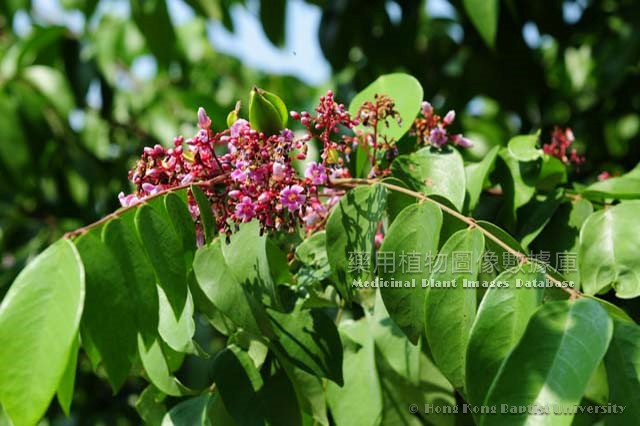
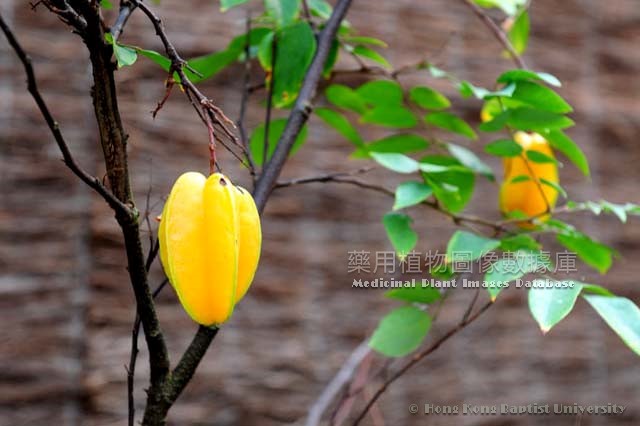
|
English Name |
Carambola, Common Averrhoa, Carambola, Caramba, Country Gooseberry, Averrhoa, Blimbing |
|
Latin name |
Averrhoa carambola L. |
|
Family & Genus |
Oxalidaceae, Averrhoa |
|
Description |
Trees, 5-12m tall. Young branches pubescent with small lenticels. Odd-pinnate compound leaves; common petioles and rachis with hairs, with 5-11 leaflets , ca. 13cm long; leaflets ovate to elliptic, 3-6cm long, ca. 3cm wide, apex acuminate, base skewed. Panicles borne at axil or on old branches, ca. 3cm long; calyx 5, red-purple, imbricately arranged, ca. 3mm long; corolla nearly campanulate, white to pale purple, ca. 5mm long, petals obovoid, arranged in a round shape; stamens 10, in which 5 are relatively short without anthers, filaments base connate; ovary 5-chambered, with 5 edges and grooves, each chamber ovules are numerous. Berry ovate or elliptic, 5-8cm long, pale yellow-green, smooth with 3-5 winged edges. Flowering: July to August, fruiting: August to September. |
|
Distribution |
Cultivated in gardens, and on village borders. Distributed in Fujian, Taiwan, Guangdong, Hainan, Guangxi and Yunnan. |
|
Part Used |
Medical part: Roots, bark, leaves, flower and fruits. Chinese name: root or root bark: Yangtaogen. Leaves: Yangtaoye. Flower: Yangtaohua. Fruits:Yangtao. |
|
Harvest & Processing |
Root or root bark: collected all over the year, excavated root, removed soil, well washed, sun-dried; cut the root bark, removed cork, taken the second layer, used fresh or sun-dried. Leaves: collected all over the year, used fresh or sun-dried. Flower: from July and August, collected when flowering, used fresh or sun-dried. fruit: collected in August and September, when the fruits turn greenish-yellow and used fresh. |
|
Chemistry |
Roots contain β-sitosterol, lupeol, 1, 5-dihydroxy-6, 7-dimethoxy-2-methyl anthraquinone 3-O-β-glucopyranoside. Leaves contain cyanidin-3-O-β-D-glucoside, cyanidin-3 and 5-O-β-D-diglucoside. Flowers contain rutin and quercetin-3-O--D-glucoside. Fruits contain tricos-1-ene, linoleic acid, hexadecanoic acid, pentacos-1-ene and γ-dodecalactone, etc. |
|
Properties & Actions |
Root or root peel: sour, harsh, neutral. Leaves: harsh, bitter, cold. Flower: sweet, neutral. Fruits: sour, sweet, cold.Roots or root bark: removing wind and damp, activating qi-flow, relieving pain, arresting seminal emission and leukorrhea. Leaves: removing wind, inducing urination, clearing heat, detoxifying and relieving pain. Flowers: arresting malaria, relieving pain, detoxifying, expelling parasites. Fruits: clearing heat, produce body fluid, inducing urination and detoxifying. |
|
Indications & Usage |
Root or root bark: Rheumatic arthralgia, osteoarthritis, paralysis, peratodynia, emissions, leucorrhea, Leaves: wind-heat type common cold, difficulty in urination, puerperal edema, superficial infection, toxic swelling, dermatitis rhus, swelling pains caused by falls. Flower: malaria, gastralgia, dermatitis rhus, sarcoptidosis. Fruits: cough due to wind-heat evil, pharyngalgia, dipsesis, stranguria caused by kidney stone, aphthous stomatitis, toothache, malarial nodule, toxic effect of alcohol.Root or root bark: oral administration: decocting, 15-30g (double dose for fresh use); or made as medicinal liquor. Leaf: oral administration: decocting, 15-30g. External: appropriate amount, fresh used smashed for application, extracted juice and coated or prepared decoction for washing. Not use for physically weak and cold person. Flower: oral administration: decocting, 9-30g. External: appropriate amount, triturated for application. Fruit: oral administration, decoction, 30-60g; eat fresh fruit, or drink extracted juice. External: appropriate amount, extracted juice for ear drippings. Not use for deficiency-cold in spleen and stomach. |
|
Examples |
1. Cough due to wind-heat evil: fresh carambola 94-125g, pestle to juice, add crystal sugar to drink; or eat fresh carambola 2-3 times a day, and 1-2 each time.
2. Malaria: carambola flower 15-24g. Decoct, and drink 2-3h before onset, patients with hepatosplenomegaly should eat an appropriate amount of fresh carambola, pestle to collect juice, drink 1 cup each time, 2 times a day.
3. Pyretic thirst, scanty and astringent urine: decoct (Carambola) fresh leaves and drink the decoction to replace tea.
4. Chronci head wind: fresh root of carambola 30-45g, beancurd 120g. Stew and eat, one time a day. |
|
Permanent URL:https://sys01.lib.hkbu.edu.hk/cmed/mpid/detail.php?herb_id=D00934 |
|
|
|


