|
Bryophyllum pinnatum (L.f) Oken
|
English Name |
Air-plant, Life-plant, Floppers |
|
Latin name |
Bryophyllum pinnatum (L.f) Oken |
|
Family & Genus |
Crassulaceae, Bryophyllum |
|
Description |
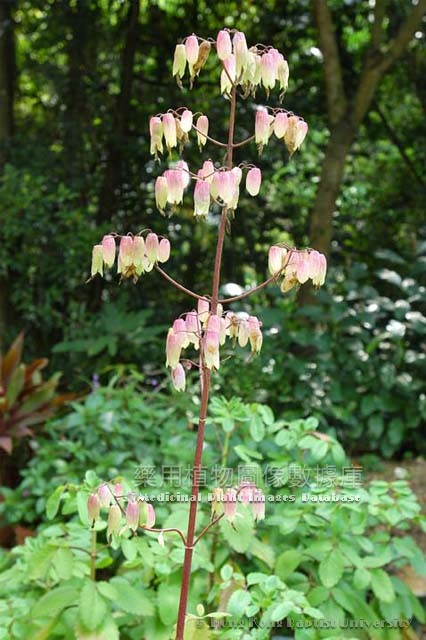
Perennial fleshy herbs, 40-150cm tall; stem branched, erect, glabrous, nodes prominent, upper part purple red, with dense elliptic lenticels, lower part sometimes slightly woody; pinnate compound leaves, 10-30cm long, compound leaves with 3-5 pieces of leaflets; leaflets oblong to elliptic, 6-8cm long, 3-5cm wide, apex blunt, margin with crenae, bottom of crenae easily sprouting, buds growing up and becoming a new plant after landing; small petioles 2-4cm long. Panicle acrogenous, flowers large, bisexual, 10-40cm long, drooping; two pieces of bracts, leaf-shaped; calyx cylindrical, membranaceous, 2-4cm long, light green or yellow white; corolla salverform, up to 5cm long, base slightly enlarged, into tubular upward, lobes 4, oval-lanceolate, pale red or purple red; stamens 8, borne at the base of corolla, connate with corolla tube, filaments long; scales nearly rectangular; carpels 4; upper part separated, base joint, style slender, outside of base with 1 scale, rectangular. Follicles, wrapped within calyx and corolla; seeds small, numerous, with stripes. Flowering: March to May; fruiting: April to June. |
|
Distribution |
Growing in mountain, ravine, roadside, moist grasslands. Also cultivated in greenhouse and gardens. Distributed in Fujian, Taiwan, Guangdong, Guangxi, Yunnan and etc. |
|
Part Used |
Medical part: root and entire plant. Chinese name: Luodishenggen. |
|
Harvest & Processing |
Collected all over the year and used fresh. |
|
Chemistry |
Leaves contain cis-aconitic acid, ascorbic acid, p-coumaric acid, ferulic acid, syringic acid, coffeic acid, p-hydroxybenzonic acid and some other organic acid, quercetin and kaempferol, etc. Entire plant contains β-sitosterol, quercetin-3-O-α-rhamnopyranosyl-α-L-arabinopyranoside. |
|
Pharmacology |
Anti-bacteria and anti-tumor, and anti-mutagenesis. |
|
Properties & Actions |
Bitter, sour, cold.Cooling blood, arresting bleeding, clearing heat and detoxifying. |
|
Indications & Usage |
Hematemesis, traumatic hemorrhage, injuries caused by falls, anthracia and furunculosis, mammary abscess, mammary carcinoma, erysipelas, ulcer, scalding injuries, gastralgia, arthralgia, swelling and pain in throat, cough with lung heat.Internal: decocting, fresh entire plant 30-0g; or extracted juice. External: appropriate amount, triturated for application; or extracted juice, sundried, and powdered; or gargle with extracted juice. Use with care in case of deficiency-cold of spleen and stomach. |
|
Examples |
1. Injuries from fall, hematemesis: 7 fresh leaves of Air-plant. Pestle and collect juice, prepare with liquor, brown sugar, stew and drink.
2. Deep-rooted boil and superficial infection, unknown pyogenic infections: fresh leaves of Air-plant 30-60g, pestle and collect juice, prepare with honey and drink; apply the residues onto the affected lesions. |
|


