|
Abelmoschus esculentus (L.) Moench
|
English Name |
Okra, Edible Abelmoschus, Gobo, Gombo, Lady’s-finger |
|
Latin name |
Abelmoschus esculentus (L.) Moench |
|
Family & Genus |
Malvaceae, Abelmoschus |
|
Description |
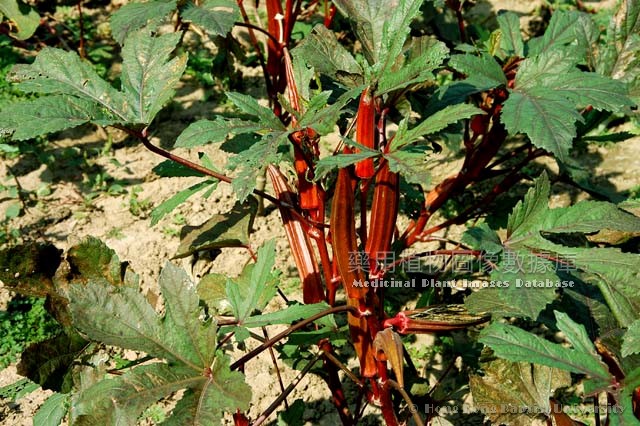
Annual herbs, 1-2m tall. Stem cylindrical with a few sparse prickles. Leaves alternate; petioles 7-15cm long, long bristles; stipules linear, 7-10mm long, and sparsely covered with bristles. Leaves palmate with 3-7 lobes, 10-30cm in diameter, lobes are wide to narrow, sparsely covered with bristles on both sides, margin has coarse serrations and notches. Flowers solitary at the axil, pedicels 1-2cm long, sparse and coarse bristles; calyx campanulate, longer than bracteoles, and densely star-shaped with short hairs; flowers yellow while base purple inside, 5-7cm in diameter, petals obovate, 4-5cm long. Capsule tubular and spire-shaped, 10-25cm long, 1.5-2cm in diameter, apex has long beak, covered with sparse and coarse bristles; seeds spherical and numerous, 4-5mm in diameter, with hairy veins. Flowering: May to September. |
|
Distribution |
Introduced for cultivation in Hebei, Shandong, Jiangsu, Zhejiang, Fujian, Taiwan, Hubei, Hunan, Guangdong, Hainan, Guangxi, Yunnan and etc. Originating in India. |
|
Part Used |
Medical part: roots, leaves, flowers or seeds. Chinese name: Qiukui. |
|
Harvest & Processing |
Roots: excavated in November to Feb of the next year, removed soil, sun-dried or fire-dried. Leaves: harvested in Sept. to Oct and sun-dried. Flowers: harvested in June to April, and sun-dried. Seeds: harvested when fruits mature in Sept. to Oct, threshed, and sun-dried. |
|
Properties & Actions |
Tasteless, cold.Benefiting pharynx, treating stranguria, lactogenesis and regulating menstruation. |
|
Indications & Usage |
Swelling of throat, drenching and infrequent urination, insufficient milk post partum, irregular menstrual periods.Oral administration: decocting, 9-15g. |
|


