|
Melastoma dodecandrum Lour.
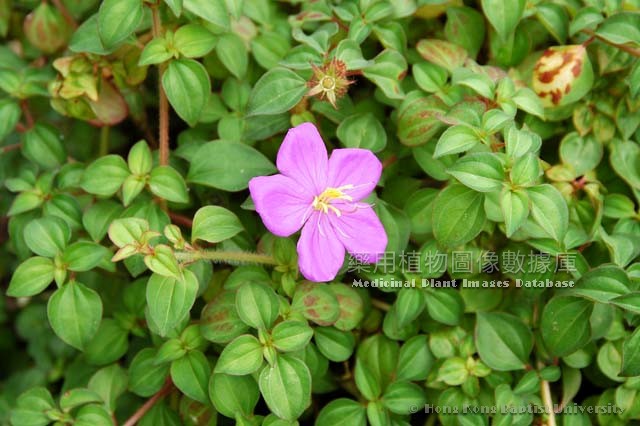
|
English Name |
Twelve-stamened Melastoma, Twelvestamened Melastoma |
|
Latin name |
Melastoma dodecandrum Lour. |
|
Family & Genus |
Melastomataceae, Melastoma |
|
Description |
Short trees, 10-30cm tall. Stem creeping upwards, rooted section by section, much branched, scattered, overground strigose. Leaves opposite; peduncle 2-6mm long; blades strongly papery, ovate or elliptic, 1-4cm long, 0.8-3cm wide, apex acute, base broadly cuneate, entire or densely shallowly serrulate; basal veins 3-5. Cyme terminal, has flowers 1-3, base lobate involucres 2, peduncle 2-6mm long; flowers 5, strigose, base enlarged to be conical, fascicular in 2-3, lobes lanceolate, margin bristled, lobe has 1 lobelet; petal light purple to purple red, rhomboid obovate, upper slightly deflective, 1.2-2cm long, 1-1.5cm wide, apex has 1 seta, sparse and ciliolate; stamens 5 long 5 short, longer connectivum base stretching, bend, tail end has 2 tubercles; short connectivum not stretching, connectivum base has 2 tubercles; ovary inferior, apex bristled. Capsule spheric, flattened truncate, fleshy, uncracked, persistent calyx strigose. Flowering: May to July, fruiting: July to September. |
|
Distribution |
Growing in hill-slope grass at altitude below 1,250m. Often seen in acid soil. Distributed in Zhejiang, Jiangxi, Fujian, Hunan, Guangdong, Guangxi ,Guizhou and etc. |
|
Part Used |
Medical part: aboveground parts, fruits and roots. Chinese name: aboveground parts: Dinie. Fruits: Dinieguo. Roots: Diniegen. |
|
Harvest & Processing |
Aboveground parts: harvested from May to June, washed, removed impurities, sun-dried or baked to dry. Fruits: harvested in batches from July to September when fruits mature, and sun-dried. Roots: excavated in Aug-Dec., washed, cut up, sun-dried or used fresh. |
|
Chemistry |
Aboveground parts mainly contain tannin. |
|
Properties & Actions |
Ground part: sweet, harsh, cool. Fruits: sweet, warm. Root: bitter, little sweet, neutral.Aboveground parts: clearing heat-toxin, promoting blood circulation and relieving hemorrhage. Fruits: tonifying kidney for nourishing the blood, relieving hemorrhage and quieting the fetus. Roots: promoting blood circulation, relieving hemorrhage, disinhibiting dampness and detoxifying. |
|
Indications & Usage |
Aerial parts: chronic fever, pulmonary abscess, pharyngeal swelling, toothache, jaundice, algomenorrhea, metrorrhagia and metrostaxis, postpartum abdominalgia, scrofula, anthracia, furunculosis, venomous snake bites. Fruits: damage of essence with renal asthenia, relative weakness in the loins and knees, hematasthenic flaccidity, deficiency of vital energy and debilitation, hypermenorrhea, metrorrhagia and metrostaxis, restless fetal movement. Root: algomenorrhea, difficult labour, postpartum abdominalgia, metrorrhagia and metrostaxis, leucorrhea, hematemesis, dysentery, jaundice, rheumatalgia, toothache, scrofula, hernia.Aboveground parts: oral administration: decocting, 15-30g, fresh products double in amount; or fresh products pounded to extract juice. External application: appropriate amount, smashed for applying or decocted for washing. Fruits: oral administration: decocting, 10-30g; or made as medicinal liquor. Roots: oral administration: decocting, 9-15g (fresh products double in amount); or pounded to extract juice. External application: appropriate amount, decocted for washing or smashed for applying. Use with caution in cases of pregnancies. |
|
Examples |
1. Lung abscess: fresh twelve-stamened melastoma 30g, black egg shell 2. Stew with boiling water and eat.
2. Anemia, hypermenorrhea, functional uterine bleeding, restless fetal movement: twelve-stamened melastoma fruit 15-30g. Decoct in water and swallow.
3. Dysentery: melastoma dodecandrum root 60g, decoct in water and swallow. Crystal sugar as the guider, 1 dose a day. |
| Link to |
 Chinese Medicine Specimen Database Chinese Medicine Specimen Database
|
|


