|
Alisma orientalis (Sam.) Juzep.
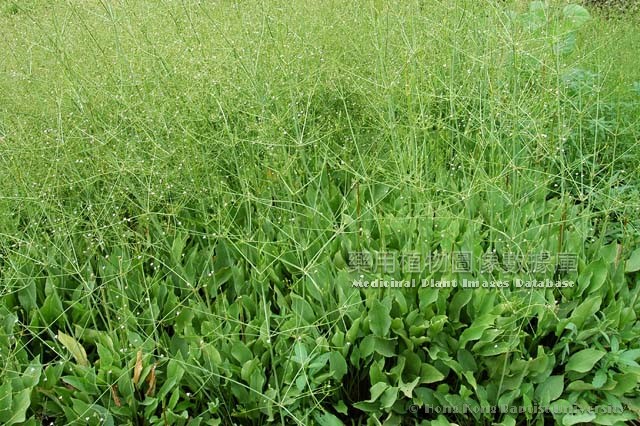
|
English Name |
European Waterplantain, Common Water-plantain |
|
Latin name |
Alisma orientalis (Sam.) Juzep. |
|
Family & Genus |
Alismataceae, Alisma |
|
Description |
Perennial helophyte, 50-100cm tall. Underground with tubers, spherical, diameter up to 4.5cm, covering skin brown, dense numerous fibrous roots. Leaves radicicolous; petioles up to 50cm, base extends to middle sheathing, 5-20mm wide; leaves wide elliptic to ovate, 5-18cm long, 2-10cm wide, apex acute or mucronulate, base broad cuneate, round or slightly cordate, margin entire, smooth both sides; leaf veins 5-7. Scapes extracted from clustered leaves, 10-100cm long, inflorescences usually with 3-5 layer branches, lanceolate or linear bracts under branches, whorled branches usually branched once more, form conically compound umbel, small pedicels different length; bracteoles lanceolate to linear, acute; calyx 3, broad ovate, green or slightly green, 2-3mm long, persistent; petals obovoid, membranous, smaller than calyx, white, falling; stamens 6; pistils numerous, distinct; ovary obovoid, lateral flat, style pleurogenous. Achenes numerous, flat, obovoid, 1.5-2mm long, ca. 1mm wide, back with two shallow indentations, brown, style persistent. Flowering: June to August,fruiting: July to September. |
|
Distribution |
Growing in marsh edges. Can be cultivated. Distributed in Northeast, East and Southwest China, Hebei, Xinjiang, Henan and etc. The medicinal materials are mainly produced in Fujian, Sichuan, Jiangxi, mostly found cultivated. Now also produced in Guangdong, Guangxi, Hubei, Hunan and etc. |
|
Part Used |
Medical part: tuber, leaves and fruits. Chinese name: tube: Zexie. Leaves: Zexieye. Fruits: Zexieshi. |
|
Harvest & Processing |
Tuber: in late Dec Of the very year of planting when most leaves get withered and yellow, excavated tuber, removed soil and stem leaves, but the middle leaflet remained in case that black juice flow out and dried upon smokeless coal fire. Put inside the basket when still hot, removed fibrils and rough barks. leaves: harvested from June-Sept, used fresh or sun-dried. Fruits: picked in batches in summer and autumn when fruits ripen. Cut off fruits, wisped, hung in open air, threshed and sun-dried. |
|
Chemistry |
Tuber contains alisol A, B, C, alisol A monoacetate, alisol B monoacetate, alisol C monoacetate, epialisol A, alismol, choline, saccharides and K, Ca, Mg, etc. Leaves contain vitamin C and minerals such as Mn, Ca. Fruits contain starch. |
|
Pharmacology |
Tuber: urination-inducing, blood-pressure-lowering and cholesterol and anti-atherosclerotic, anti-fatty liver, anti-inflammatory, hpyerglycemic and weight-losing. |
|
Properties & Actions |
Tuber: sweet, tasteless, cold. Leaves: salt, neutral. Fruits: sweet, neutral.Cubes: promoting diuresis clearing and dampness, reducing heat for relieving strangury. Leaves: benefiting kidney qi, suppressing cough, freeing arteries and veins and promoting lactation. Fruits: dispelling wind-dampness and benefiting kidney qi. |
|
Indications & Usage |
Stem tuber: difficulty in urination, difficulty and pain while urinating induced by pyretic stranguria, edema and tumescence, diarrhea, dizziness induced by phlegm and retained fluid and emissions. Leaves: consumptive disease, cough, infrequent lactation, swellings and sores. fruits: migratory arthralgia, deficiency of the kidney and weak health, diabetes.Tuber: oral administration: decocting, 6-12g; or made as pills or powders. Not use in patients with deficiency of kidney and spermatorrhea, or without damp-heat. Leaves: oral administration: decocting, 15-30g. External application: appropriate amount, smashed for applying. Fruits: oral administration: decocting, 6-9g. |
|
Examples |
1. Edema, difficulty in urination: alisma orientale and largehead atractylodes, 12g each, plantain seeds 9g, tuckahoo peel 15g, Water-melon peel 24g. Decoct in water and swallow.
2. Accumulation of fluid-retention in the body, dizziness and vertigo, vomiting phlegm and saliva: alisma orientale and largehead atractylodes 9g each, hindu lotus leaf-base 5 pieces, common chrysanthemum 6g, fortune bogorchid 3g. Infuse or decoct to replace tea. |
| Link to |
 Chinese Medicinal Material Images Database
Phytochemical Image Database Chinese Medicinal Material Images Database
Phytochemical Image Database
|
|


