|
Paulownia tomentosa (Thunb.) Steud.
|
English Name |
Royal Paulownia, Paulownia, Princess-tree, Empress-tree, Princess Tree, Foxglove Tree |
|
Latin name |
Paulownia tomentosa (Thunb.) Steud. |
|
Family & Genus |
Scrophulariaceae, Paulownia |
|
Description |
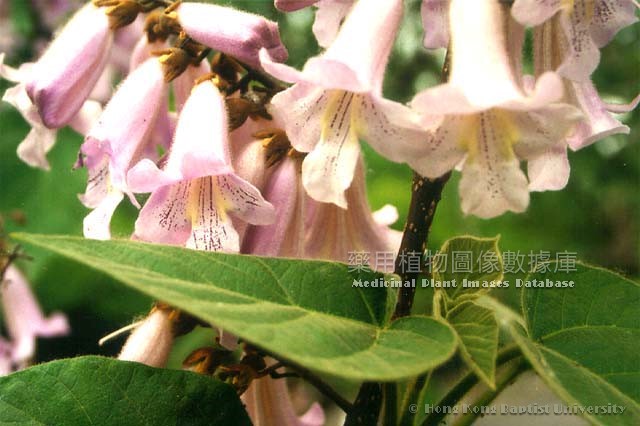
Arbor up to 20m tall, crown broadly umbellate, bark brownish grey, branchlet with distinct lenticels, usually with adhesive short glandular hairs before maturity. Lamina heart shaped, up to 40cm long, apex sharp and pointed, entire or undately lobed, hairs on upper surface sparse, on lower surface dense or comparatively sparse, the greyish brown branch like hairs on the lower surface of old leaves usually with stipe and 3-12 thin and long filamentous branches, the leaves on new branches comparatively big, hairs usually not branched, sometimes with adhesive glandular hairs, petiole usually with adhesive short glandular hairs. Lateral branch of inflorescence branch undeveloped, approximately half of central main branch or slightly shorter in length, thus, inflorescence pyramidical or narrow conical, generally less than 50cm in length, rarely longer, common peduncle of small raceme 1-2cm long, nearly equal to peduncle in length, with 3-5 flowers; calyx shallowly campanulate, about 1.5cm long, outer tomentum not falling off, divided to middle part or beyond middle part, calyx tooth ovate long circular; corolla purplish, funnel-shaped campanulate, 5-7.5cm long, curved about 5mm from tube base, suddenly expanding upward, outer surface with glandular hairs, inner surface nearly hairless, limb 2 labiate, about 4cm in diameter; stamen up to 2.5cm long; persistent calyx not reflexed, pericarp about 1mm thick; seed together with wing about 2.5-4mm long. Flowering: April to May, fruiting: August to September. |
|
Distribution |
Distributed in Liaoning, Hebei, Shandong, Jiangsu, Anhui, Jiangxi, Henan, Hubei and etc. |
|
Part Used |
Medical part: bark, flowers, fruits, leaves and roots. Chinese name: bark: Paotongshupi. Flowers: Paotonghua. Fruits: Paotongguo. Leaves: Paotongye. Root: Paotonggen. |
|
Harvest & Processing |
Bark: collected throughout the year, used fresh or sundried. Flower: collected in spring when flowering, sun-dried or used fresh. Fruit: collected in summer and autumn, used fresh or sundried. Roots: excavated in autumn, well washed, used fresh or sundried. |
|
Chemistry |
Bark contains acteoside, coniferin, syringin and catalpol. Xylem contains caflelc acid sugar esters A, B, paulownin, sesamin, lignin and holocellulose. Trunk contains campneoside I, II and martynoside. Leaf contains aucubin paulownioside, verbascoside, isoverbascoside and ursolic acid, etc. Flower contains essential oils, etc. |
|
Pharmacology |
Antibacterial, anti-viral, sedative, phlegm-removing, pant-calming, anticancer and the effect of insecticides strengthening. |
|
Properties & Actions |
Bark: bitter, cold. Flower: bitter, cold. Fruit: bitter, little cold. Leaves: bitter, cold. Root: little bitter, little cold.Bark: removing wind and damp, dissipating swelling and detoxifying. Flower: clearing lung, benefiting throat, detoxifying, dissipating swelling. Fruit: removing phlegm, checking cough and relieving asthma. Leaf: clearing heat, detoxifying, arresting bleeding and dispersing swelling. Root: removing wind, easing pain, detoxifying and activating blood. |
|
Indications & Usage |
Bark: rheumatic pyretic arthralgia, stramgutia, erysipelas, hemorrhoids and swelling toxicity, discharging fresh blood stools, swelling pain due to surgical trauma, fracture. Flower: coughing with lung heat, acute tonsillitis, bacillary dysentery, acute enteritis, acute conjunctivitis, parotitis, furuncles, sores and acariasis. Fruits: chronic bronchitis, coughing and stethocatharsis. Leaves: superficial infections, furunculosis and swelling, hemorrhage caused by trauma. Root: rheumatic pyretic arthralgia, pain of bones and muscles, pyocutaneous disease and swelling, injuries from falls.Bark: oral administration: decocting, 15-30g. External application: appropriate amount for fresh, triturated for application; or decocted for application. Flower: oral administration: oral administration: decocting, 10-25g. External application: appropriate amount for fresh, smashed for application; or made into plaster for application. Fruit: oral administration: decocting, 15-30g. Leaf: oral administration: decocting, 15-30g. External application: steamed with vinegar for application, triturated for application or extracted juice for application. Root: oral administration: decocting, 15-30g. External application: appropriate amount for fresh, smashed for application. |
|
Examples |
1. Anthracia sores, cellulitis, hemorrhoids and fistula, malignant boil: take royal paulownia peel, decoct in water and apply externally.
2. Parotitis: royal paulownia flower 24g, white sugar 30g. Decoct in water, infuse with white sugar and swallow.
3. Unknown pyogenic infections: royal paulownia flower or leaves, buddleja 15g each. Pestle and apply to the affected lesions.
4. Hemafecia, hemorrhage due to hemorrhoids: an appropriate amount of royal paulownia bark and Chinese Chives. Pestle together, apply to the affected lesions, wrap up and fix. |
| Link to |
 Chinese Medicine Specimen Database Chinese Medicine Specimen Database
|
|


