|
|
|
Thymus mongolicus Ronn
|
English Name |
Common Thyme, |
|
Latin name |
Thymus mongolicus Ronn |
|
Family & Genus |
Lamiaceae, Thymus |
|
Description |
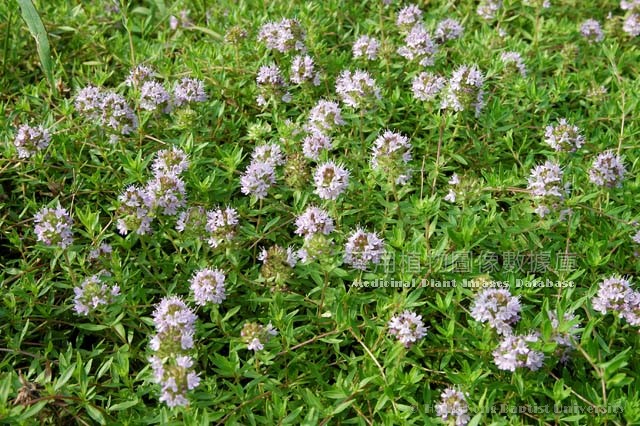
Subshrub. Sterile branch grown from the end of stem or basal part, spray 2-10cm high, densely covered with invert or slightly extending sparse soft hairs below inflorescence, hair turning short and sparse downward. with 2-4 pairs of leaf; petiole in lower part about 1/2 of lamina in length, petiole in upper part curled and short; lamina ovate, 4-10mm long, lateral vein 2-3 pairs, glandular dots more or less distinct. Inflorescence capitate; calyx tubularly campanulate or narrowly campanulate, 4-4.5mm long, inner surface with white hair ring in laryngeal part, upper lip with 3 teeth, teeth triangular, lower lip longer or nearly equal to upper lip in length, teeth drill shaped, each teeth with eyelash or without; corolla purplish red to pink, 6.5-8mm long, upper lip straight stretching, slightly depressed, lower lip extending, 3 lobed, middle lobe comparatively long, netlet nearly round or ovate, smooth. Flowering: July to August. |
|
Distribution |
Growing in montane, by streamsides, in miscellaneous grass, on hill-slopes and seaside hills. Distributed in Hebei, Shanxi, Shaanxi, Gansu and Qinghai. The medicinal materials are mainly produced in Hebei, Shanxi, Henan and etc. |
|
Part Used |
Medical part: whole plant. Chinese name: Bailixiang. |
|
Harvest & Processing |
Harvested in July-August, washed, used fresh or sundried. |
|
Chemistry |
Whole plant contains essential oil, flavonoids, triterpenoids, monoterpene glucosides, organic acids and trace elements, etc. |
|
Pharmacology |
Anti-inflammatory and painkilling. |
|
Properties & Actions |
Taste pungent, neutral in nature, mild-toxic.Dispelling wind and suppressing cough, invigorating spleen and promoting qi-flowing, disinhibiting dampness and relieving strangury. |
|
Indications & Usage |
Headache due to common cold, cough, whooping cough, pain in gastric cavity and abdomen, dyspepsia, vomiting and diarrhea, toothache, painful urination, eczema and pruritus, anthracia and swelling pain.Oral administration: decocting, 9-12g; or powdered; or made as medicinal liquor. External application: appropriate amount, powdered for dusting; or decocted for washing. |
|
Permanent URL:https://sys01.lib.hkbu.edu.hk/cmed/mpid/detail.php?herb_id=D01123 |
|
|
|


