|
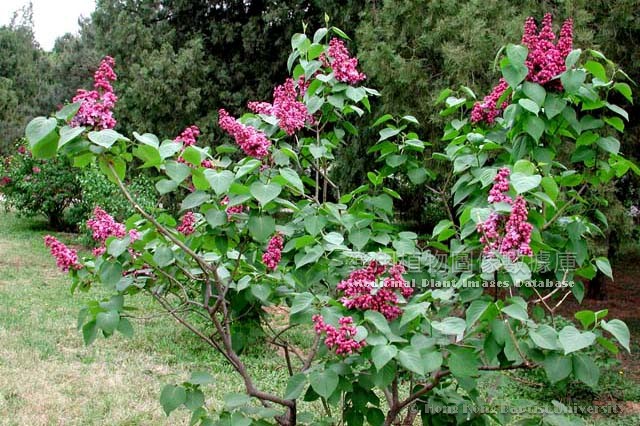
Syringa villosa Vahl.
|
English Name |
Syringa villosa, |
|
Latin name |
Syringa villosa Vahl. |
|
Family & Genus |
Oleaceae, Syringa |
|
Description |
Shrub, 3m high. Lamina broad elliptic to long elliptic, 5-18cm long. Panicle basidixed, up to 25cm long, corolla light pink to white. Capsule cylindrical, smooth. Flowering: May to June; fruiting: August to September. Photophilous plant, slight shade, frigostable, xeric, cold, moist climate preferred. |
|
Distribution |
Mainly Distributed in Liaoning, Hebei, Shanxi, and Shaanxi, etc. Also distributed in the north of North Korea. Cultivated by seeding, easy to survive if transplanting. |
|
Part Used |
Medical part: flower bud. Chinese name: Hongdingxiang. |
|
Harvest & Processing |
Collected when flower bud turn bright red from green. After collected, removed pedicel, and sun-dried. |
|
Chemistry |
Flower bud contains volatile oil, mainly including Eugenol, Acetyleugenol, and a small amount of Caryo-phyllene, Humulene, Chavicol, α-Ylangene. Buds also contain four flavonoid derivatives, including Rhamnetin, Kaempferol, Oleanolic acid, Eugenin, Eugenitin and Isoeugenitin, etc. |
|
Pharmacology |
Antibacterial. |
|
Properties & Actions |
Pungent, warm.Warming inside, nourishing kidney and descending the adverse qi. |
|
Indications & Usage |
Warms gastria to dissipate cold, calms the adverse-rising energy to stop vomiting.Oral administration: decocting, 1.5-5g; or made as pills or powders. External application: powdered for application. |
|
Permanent URL:https://sys01.lib.hkbu.edu.hk/cmed/mpid/detail.php?herb_id=D01159 |
|
|


