|
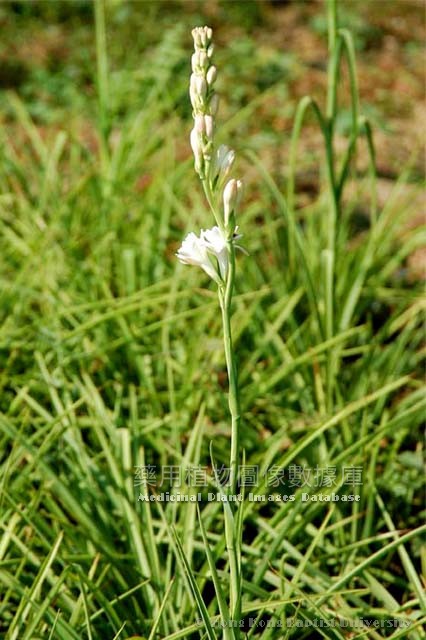
Polianthes tuberosa Linn.
|
English Name |
Tuberose, |
|
Latin name |
Polianthes tuberosa Linn. |
|
Family & Genus |
Amaryllidaceae, Polianthes |
|
Description |
Perennial herbs, up to 1 meter high. With tuberous rhizomes; stems erect, unbranched. Basal leaves 6-9 clustered, linear, 40-60cm long, about 1cm wide, apex pointed, dark green, leaves on scapes adsperse, gradually become smaller upward, bracteal. Spike terminal, each bract with 2 flowers, bracts green; flowers opposite, milky white, fragrant; 3.5-7cm long; Perianth tube length 2.5-4cm, base slightly curved; perianth lobes 6, oblong-lanceolate, 1.2-2cm long, blunt; stamens 6, inserted in perianth tube, stored inside; ovary inferior, 3 chambers, style slender, stigma 3 cleft. Capsule ovoid, apex with persistent perianth; seeds numerous, slightly flat. Flowering: July to September. |
|
Distribution |
Mostly seen in gardens. Can be cultivated. Originating in Mexico. |
|
Part Used |
Medical part: roots. Chinese name: Wanxiangyu. |
|
Harvest & Processing |
Excavated bulbs from Sept-Oct, washed, and sun-dried. |
|
Chemistry |
Roots contain saponin 1.8%, mainly tigogenin, hecogenin and 9-dehydrohecogenin. Flowers contain essential oils 0.08%-0.14%: mainly geraniol, nerol, farnesol, syringol and methyl o-aminobenzoate. |
|
Properties & Actions |
Sweet, tasteless, cool.Clearing heat-toxin. |
|
Indications & Usage |
Anthracia and swelling toxicity.External application: appropriate amount, smashed for applying. |
|
Permanent URL:https://sys01.lib.hkbu.edu.hk/cmed/mpid/detail.php?herb_id=D01197 |
|
|


