|
Spirodela polyrrhiza (Linn.) Schleid.
|
English Name |
Common Ducksmeat , |
|
Latin name |
Spirodela polyrrhiza (Linn.) Schleid. |
|
Family & Genus |
Lemnaceae, Spirodela |
|
Description |
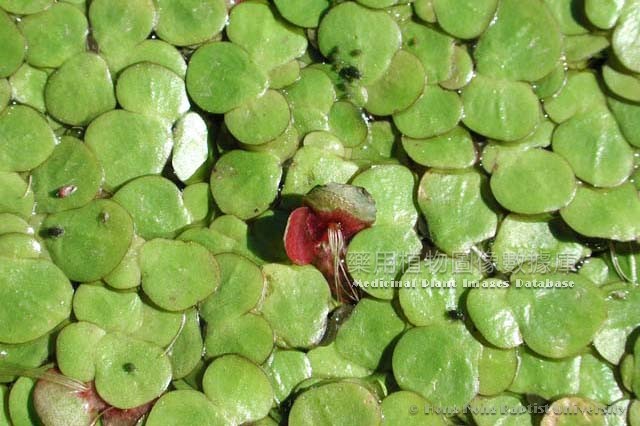
Perennial small herb, floating on water surface. The root 5-11 fascicled, minute, fibrous, 3-5cm long. New buds produced at the side of insertion on root, the new buds connected by a extenuated stalk before separation from the maternal body. Thallus flattened, solitary or 2-5 clustered, broadly obovate, length 4-10mm, width 4-6mm, apex obtuse, slightly concave above, dark green, below purple, with inconspicuous 5-11 palmate veins. Inflorescences grown in the incision of thallus edge; flowers herbaceous, monoecious; spathe bag-shaped, short and small, bilabiate, 2 male flowers and 1 female flower inside, no perianth; 2 stamens in male flower, anther 2 chambers, filaments slender; female flower with pistil 1, ovary sessile, 1 chamber, with erect ovules 2, styles short, stigma flat or circular. The fruit rounded, edge with wings. Flowering: April to June, fruiting: May to July. |
|
Distribution |
Growing in marsh, paddy fields, lakes or still water. Distributed in the northern and southern parts of China. The medicinal materials are mainly produced in Hubei, Jiangsu, Zhejiang, Fujian, Sichuan and etc. |
|
Part Used |
Medical part: entire plant. Chinese name: Fuping. |
|
Harvest & Processing |
Collected from June to September. After fished out, removed foreign matters, well washed, and sun-dried. |
|
Chemistry |
Contains orientin, luteolin-7-monoglycoside, vitexin, malonylcyanidin-3-monoglucoside, β-carotene, luteine, epoxyluteine, violaxanthin, neoxanthin, lipid 8%, protein 24.4%. Lipid mainly contains linolenic acid, palmitic acid, linoleic acid, protein: leucine, aspartic acid and glutamic acid 9.05%-9.79%. |
|
Pharmacology |
Diuretic, antifebrile and cardiotonic. |
|
Properties & Actions |
Pungent, cold.Inducing perspiration to relieve exterior syndrome, promoting eruption, relieving itching, inducing urination, dispersing swelling, clearing heat and detoxifying. |
|
Indications & Usage |
Exterior syndrome due to wind-heat, measles without adequate eruptions, bastard measles and pruritus, edema, retention of urine, sores and acariasis, erysipelas, scalding injuries.Oral administration: decocting, 3-9g, fresh herb 15-30g; or extracted juice; or made as pills or powders. External application: appropriate amount, prepared decoction for fumigating and washing; powdered for dusting or application. |
|
Examples |
Treat anthracia: an appropriate amount of common ducksmeat, pestle and collect juice, lanceleaf anisetree root (osmanthus fragranse) root peel, grind into a powder, take a spoon of powder, add juice and mix, apply externally, thin at the center and thick on margin, with a blank left over in the middle. |
| Link to |
 Chinese Medicine Specimen Database Chinese Medicine Specimen Database
|
|


