|
|
|
Arundo donax Linn.
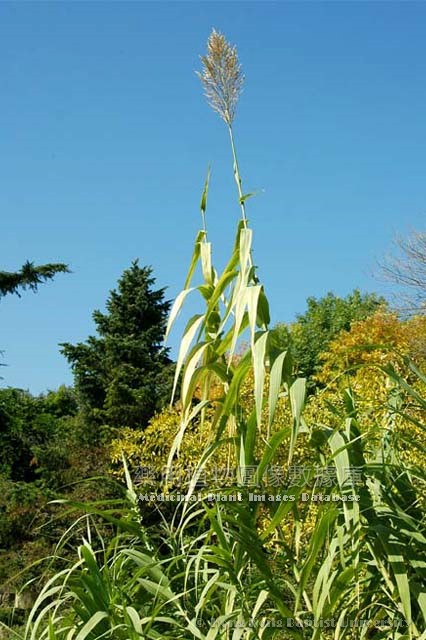
|
English Name |
Giantreed, |
|
Latin name |
Arundo donax Linn. |
|
Family & Genus |
Poaceae, Arundo |
|
Description |
Perennial herbs. With rhizome, fibrous root stout. Culm erect, 2-6m tall, diameter 1-1.5cm, usually with branches. Leaf sheath longer than internodes, glabrous or its neck has long pubescence, ligules membranous, truncated, ca. 1.5mm long, apex with short fine hairs; leaves flat, 30-60cm long, 2-5cm wide, surface and margin slightly coarse when young. Panicles dense, 30-60cm long, branches dense, upwards oblique, spikelets with 2-4 flowers; caryopsis lanceolate, 8-10mm long, with 3-5 veins; lemma also with 3-5 veins, middle vein expanded to 1-2mm long short awn, at the back below the centre densely white pubescence that's slightly shorter than lemma, base plate ca. 0.5mm long, length of palea ca. half of that of lemma. Flowering: October to December. |
|
Distribution |
Growing on stream banks, humid thick soil around houses. Distributed in Southwest and South China, Jiangsu, Zhejiang, Hunan and etc. The medicinal materials are mainly produced in Sichuan. |
|
Part Used |
Medical part: rhizome, juice extracted by heating stalk and young plant. Chinese name: roots and stem: Luzhugen. Juice extracted by heating stalk: Luzhuli; young plant: Luzhusun. |
|
Harvest & Processing |
Root and stem: collected the entire plant in summer, cut root and stem, well washed, removed fibrous root, sliced or sun-dried complete part. Juice extracted by heating stalks: fresh giantreed, cut into 30-50cm long, removed nodes, broke into two parts, heated the middle part to let juice flow out from two ends. Young plant: collected in spring, well washed and used fresh. |
|
Chemistry |
Roots and stems contain indole derivatives, such as N, N-dimethyltryp-tamine,5-methoxy-N-methyl-tryptamine, dehydrobufotenine, etc. triacontane, α-amyrinacetate, β-amyrin acetate, triacontanol and campesterol, etc. Flowers contain indole derivatives, gramine and its Nb-oxide, gramine methohydroxide, N, N-dimethyltryp-tamine hydroxide, 3, 3'-bis(indolylmethyl) dimethyl ammonium hydroxide and eleagnine, etc. |
|
Pharmacology |
Decompressing, spasm-removing, slightly cholinomimetic or antiadrenergic, nervous-centralis of mammal exciting. |
|
Properties & Actions |
Root stem: bitter, cold, sweet. Juice from backed stem: bitter, cold. Tender: bitter, cold.Root and stem: clearing heat, reducing fire, promoting the production of body fluid, relieving restlessness and inducing urination. Juice extracted by heating stalks: clearing heat and removing restlessness. Young plant: clearing heat and reducing fire. |
|
Indications & Usage |
Rhizome: pyreticosis and dipsosis, osteopyrexia, hematemesis, pyretic stranguria, difficulty in urination, anemogenous toothache. Juice extracted from burnt stem: infantile chronic fever and infantile convulsions. Tender seedling: hematemesis due to lung-heat, osteopyrexia, dizziness, pyretic stranguria, otitis media, toothache.Rhizome: oral administration: decocting, 15-30g; or prepared plaster. External: appropriate amount, triturated for application. Juice extracted by heating stalks: oral administration: decocting, 15-30g. Young plant: oral administration: decocting, fresh 15-60g; or prepared plaster. External: appropriate amount, extracted juice for ear drippings. |
|
Examples |
1. Clearing lung heat, poisoned after eating plagued horse meat: take root and pestle natural juice, decoct and swallow.
2. Treat hematemesis due to lung heat: Giantreed sprout 500g, pestle juice, add white sugar and swallow. |
|
Permanent URL:https://sys01.lib.hkbu.edu.hk/cmed/mpid/detail.php?herb_id=D01220 |
|
|
|


