|
|
|
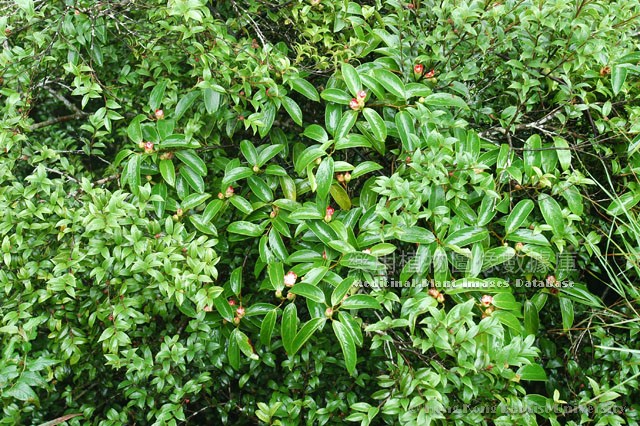
Kadsura coccinea Lem.
|
English Name |
Scarlet Kadsure, Blacktiger Resurrectionlily |
|
Latin name |
Kadsura coccinea Lem. |
|
Family & Genus |
Schisandraceae, Kadsura |
|
Description |
Evergreen woody climber, 3-6m long, whole plant hairless. Lower part of stem hidden in soil, upper part twining, branch cylindrical, brownish black, sparsely grown with white punctate lenticels. Simple leaf alternate; petiole 1-2.5cm long; leaf coriaceous, long circular to ovate lanceolate, 7-18cm long, tip blunt or short and gradually pointed, basal part broad wedge shaped or nearly round, entire, upper surface deep green, glossy, almost hairless; lateral vein 6-7 pairs, reticulate veins indistinct. Flower solitary in leaf axil, rarely in pairs, dioecious; perianth red or reddish yellow, 10-16, the biggest in middle whorl elliptic, 2-2.5cm long, 5-14cm wide, the 3 in most inner whorl fleshy; peduncle of male flower 1-4cm long, receptacle long conical, 0.7-1cm long, apex with 1-20 branched drill like attachments, stamen group elliptic or nearly spherical, 6-7mm in diameter, tip with linear attachments, with 14-48 distinct stamens, arranged into 2-5 rows, pistil group ovate or spherical, pistil 5-7 rows; filament connecting with connectivum, being thin rod shaped, filament apex embraced by two anther cells, connectivum apex round and blunt; peduncle of female flower 5-10cm long, receptacle nearly spherical, style short drill shaped, apex without peltate stigma crown, carpel 50-80, ovule terminal, prolapsing. Aggregate fruits nearly spherical, red or dark purple, 6-10cm in diameter or bigger; small berry invert orbicularovate, up to 4cm long, epicarp coriaceous, seed not exposed. Flowering: April to July, fruiting: July to November. |
|
Distribution |
Growing in forests. Distributed in Fujian, Jiangxi, Hunan, Guangdong, Hong Kong, Hainan, Guangxi, Yunnan, Guizhou and Sichuan. The medicinal materials are mainly produced in Guangxi, Guangdong, Jiangxi, Hunan, Sichuan, Guizhou, Yunnan and etc. |
|
Part Used |
Medical part: roots and cane. Chinese name: Heilaohu. |
|
Harvest & Processing |
Can be harvested throughout the year, excavated the roots and fibril, washed off sediment, cut into segments or Sliced old vane, scraped cork, chopped into segments, and sun-dried. |
|
Chemistry |
Seeds contain kadsulignan A, B. Roots and Stem contain neokadsuranin, acetylbinankadsurin A, propionyl oxokadsurane and acetoxyl oxokadsurane, etc. |
|
Pharmacology |
Pain-killing, anti-inflammatory and mental-state-calming. |
|
Properties & Actions |
Taste pungent, little bitter, warm in nature.Promoting qi-flowing for suppressing pains, dispersing stasis for freeing the network vessels. |
|
Indications & Usage |
Used for gastric and duodenal ulcers, chronic hepatitis, acute gastroenteritis, rheumatic arthralgia, injuries from falls, fractures, algomenorrhea, postpartum abdominal pain due to blood stasis, hernia pain.Oral administration: decocting, vine 9-15g; or powdered, 0.9-1.5g; or made as medicinal liquor. External application: appropriate amount, powdered for dusting; or smashed for applying; or decocted for washing. |
|
Examples |
1. Chronic gastritis, gastric ulcer: scarlet kadsure, iron holly bark, cuttlebone 30g each. Grind together into powder and swallow, 3 times a day, 6g each time.
2. Gastric and duodenal ulcer, chronic gastritis, acute gastroenteritis: tonkin pepper herb root 9-15g, decoct in water and swallow; or 0.9-1.5g, grind into powder and swallow. |
| Link to |
 Chinese Medicine Specimen Database Chinese Medicine Specimen Database
|
|
Permanent URL:https://sys01.lib.hkbu.edu.hk/cmed/mpid/detail.php?herb_id=D01279 |
|
|
|


