|
|
|
Psychotria serpens L.
|
English Name |
Creeping Psychotria, Creeping Ninenode |
|
Latin name |
Psychotria serpens L. |
|
Family & Genus |
Rubiaceae, Psychotria |
|
Description |
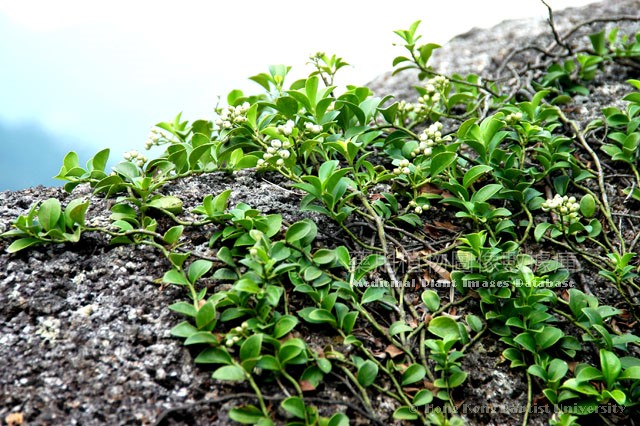
Much branched, climbing or prostrate woody vine, often holding on tree or rock with aerial roots, up to 6m long or even longer. Young branchlets glabrous or chaff-shaped pilose. Leaves opposite, thickly papyraceous; Young leaves ovate or obovate, old leaves elliptic, lanceolate, oblanceolate or obovate-oblong, length 0.7-9cm, width 0.5-3.8cm, apex obtuse pointed or acuminate, base cuneate or slightly round, lateral veins 4-10 pairs, stipules short sheath shape, membranous, sheath-shaped, caducous, leaf blade ovate, obovate or ovate-oblong, length 1.5-6cm, width 8-20mm, apex acute or obtuse, base cuneate, entire, lateral veins sparse, inconspicuous; petiole 1cm long, 2-3mm wide. Conical or corymbose cymes terminal, sometimes puberulent, with 3 divergent branches, 1.5-5cm long, peduncle up to 3cm long; bracts and bracteoles linear-lanceolate; pedicels 0.5-1.5mm long; calyx obconical, ca. 2.5mm long, calyx lobes 5, triangular, ca. 0.5mm long, corolla white, length of corolla tube nearly equal to that of lobes, 1.5-3mm long, lobes oblong, the throat white villous. Berrylike drupe globose or ellipsoid, with longitudinal edges, white, 4-7mm long; drupe stalk 1.5-5mm long. Small core globose, dorsal surface convexed, with longitudinal edges, ventral flat, length 4-6mm, diameter 3-4mm, white when ripe. Flowering: April to June, in Hainan, almost blossoming throughout the year, fruiting: the whole year. |
|
Distribution |
Growing on ground, montane, water sides, thickets or forests. Distributed in Southwest Zhejiang, East and South Fujian, Taiwan, Guangdong, Hong Kong, Hainan, Guangxi and Southwest Yunnan. The medicinal materials are mainly produced in Guangdong, Hainan, Guangxi, Fujian, Taiwan, Zhejiang and etc. |
|
Part Used |
Medical part: whole plant. Chinese name: Chuangenteng. |
|
Harvest & Processing |
Can be harvested throughout the year, washed, chopped into segments, and sun-dried. |
|
Chemistry |
Canes contain ursolic acid, stigmasterol, β-sitosterol, higheraliphatic ketone and tectoquinone, etc. |
|
Pharmacology |
Anticancer. |
|
Properties & Actions |
Taste bitter, pungent, and neutral in nature.Dispelling pathogenic wind and removing dampness, soothing the sinews and quickening the meridians and relieving swelling for suppressing pains. |
|
Indications & Usage |
Used for pain of rheumatic joints, numbness of hands and feet, psoatic strain, sciatic neuralgia, multiple anthracia, bone tuberculosis, injuries from falls, fractures, venomous snake bites.Oral administration: decocting, 15-30g, fresh products 30-60g; or pounded to extract juice; or made as medicinal liquor. External application: appropriate amount, pounded to extract juice for applying; or powdered for applying. |
|
Examples |
1. Rheumatic arthralgia: creeping psychotria 60g, white grape root 45g. Decoct in water and swallow (or add a little yellow wine); take 1 bundle, decoct in water, fumigate, wash the affected lesions.
2. Bites by toxic snakes: creeping psychotria 120g, liquor 500 ml, immerse for 1 week. Drink 1 small cup each time; dip with cotton, and smear the lesions. |
|
Permanent URL:https://sys01.lib.hkbu.edu.hk/cmed/mpid/detail.php?herb_id=D01283 |
|
|
|


