|
Pittosporum glabratum Lindl.
|
English Name |
Glabrous Pittosporum, Glabrousleaf Pittosporum, Glabrous-leaved Pittosporum, Glabrousleaf Seatung, Glabrous Leaf Pittosporum |
|
Latin name |
Pittosporum glabratum Lindl. |
|
Family & Genus |
Pittosporaceae, Pittosporum |
|
Description |
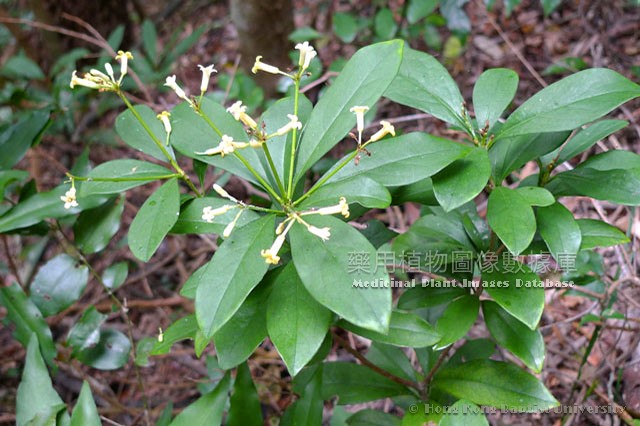
Evergreen shrub, as high as 2-3m; upper branches sometimes whorled, the whole plant glabrous. Leaves alternate; Leaves aggregated on branch top, thinly coriaceous, oblong or oblanceolate, length 5-10cm, width 2-3.5cm, apex aggregately mucronate, base cuneate, lateral veins 5-8, petiole length 0.6-1.4cm; apex shortly acute or acuminate, base cuneate, upper part green, lower part pale green, edge slightly wavy; midvein prominent. Umbels, 1-4, fascicled on top of branches or axil, usually with 6-13 flowers; bracts lanceolate, 3mm long; pedicels 0.4-1.2cm long; sepals ovate, length 2mm, with long hairs that look like eyelashes; petals separated, yellow, oblanceolate, 0.8-1cm long; stamen length (4 -) 6-7mm; ovary long ovate, glabrous, style 3mm long, stigma slightly enlarged; parietal placenta 3, and 6 ovules per placenta. Capsule ovate or elliptic, 2-2.5cm long, 2 valvular dehiscence, sometimes long cylindrical, 3.2cm long, 3 valvular dehiscence, about 6 seeds for each valve, thin peel, coriaceous, uniformly distributed on the elongated placenta; fruit stalk thick; style persistent. Seeds suborbicular, 5-6mm long, red, seed stalk 3mm long. Flowering: April, fruit ripening period: September. |
|
Distribution |
Growing on dank lands, hill-slopes and streamsides. Distributed in South Jiangsu, West Anhui, Fujian, Jiangxi, Hunan, Guangdong, Hong Kong, Guangxi, Guizhou and Sichuan. The medicinal materials are mainly produced in Sichuan, Guangxi, Guangdong, Hunan, Guizhou and etc. |
|
Part Used |
Medical part: leaves, roots and seeds. Chinese name: seeds: Guangzhiren. Leaves: Guangyehaitongye. Roots: Guangyehaitonggen. |
|
Harvest & Processing |
Seeds: picked fruits in autumn, sundried, after shuck cracked taken out seeds, sun-dried again. Leaves: harvested throughout the year, used fresh or sun-dried for powdering. Roots: harvested in autumn or throughout the year, excavated the roots or stripped root coat, removed earth, chopped into segments, and sun-dried. |
|
Properties & Actions |
Seeds: taste bitter, harsh, and neutral in nature. Leaves: taste bitter, pungent, little warm in nature. Root: taste sweet, bitter, pungent, little warm in nature.Seeds: clearing heat for disinhibiting the throat and relieving diarrhea. Leaves: detumescence and detoxifying and relieving hemorrhage. Roots: dispelling pathogenic wind and removing dampness, promoting blood circulation and freeing meridians, suppressing cough and astringing essence. |
|
Indications & Usage |
Seeds: used for upset due to asthenic fever, hydrodipsia, pharyngalgia, diarrhea, dysentery. Leaves: used for venomous snake bites, anthracia and furunculosis, burns due to hot liquids or fires, hemorrhage caused by trauma. Root: used for rheumatic arthralgia, pain in loin and legs, fall injuries and fractures, dizziness and insomnia, coughing with asthma due to consumptive disease, emissions.Seeds: oral administration: decocting, 9-15g; powdered, 1.5-3g. Leaves: external application: appropriate amount, fresh products smashed for applying; or decocted for washing; or dried products powdered for dusting. Roots: oral administration: decocting, 9-15g; or made as medicinal liquor. External application: appropriate amount, smashed for applying; or powdered for applying; or decocted for washing; or made as medicinal liquor for erasing. Not use in cases of pregnancies. |
|
Examples |
Seed:
1. Adynamic fever and thirst: beautiful St. Johnwort fruit 15g. Decoct in water and swallow.
2. Tonifying heart: pittosporm seed and poria with hostwood in equal amounts, grind into a powder. Take 3g each time, swallow with boiled water.
Leaves:
1. Bites by toxic snakes, sores and furuncles, pyogenic infections, hypersensitive cytitis: fresh glabrousleaf pittosporum leaves, pestle and apply externally, or decoct and wash the outside.
2. Syphilis: glabrous pittosporum leaves, grind into powder and smear externally.
Root:
1. Rheumatic osteodynia, postpartum shock, gastralgia, toothache: glabrous pittosporum root 9-15g. Decoct in water and swallow.
2. Rheumatic arthritis: pittosporm root 60g, fengheli 30g. Infuse into liquor 500 ml, drink 15 ml liquor each time in morning and evening. |
|


