|
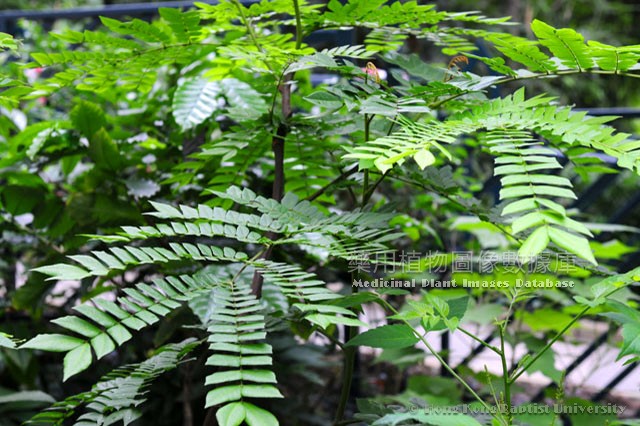
Abarema clypearia (Jack) Nislsen
|
English Name |
Common Apea-earring, Ape’s Earring, Common Monkey Earrings Pea, Manilla Tamarind, Guanymochil, Haumachil, Madras Thorn, Monkey’s Ear-rings |
|
Latin name |
Abarema clypearia (Jack) Nislsen |
|
Family & Genus |
Fabaceae, Archidendron |
|
Description |
Trees, up to 10m, branchlets without prickles, corners angled, covered with dense yellowish brown hair. Stipules caducous; leaves bipinnate; pinnae (3)4-5(-8) pairs; common petiole 4 ribs, covered with dense yellowish brown hair, between rachis pinnae and nearly petiole base with protruding glands, top pinnae 10-12 (-16) pairs of leaflets, lowest pinnae 3-6 pairs of leaflets; leaflets like skewed rhombus, 1-7cm, top leaflet the largest, grow smaller as they go lower, with slight brown short hair on both sides; base extreme asymmetry, nearly sessile. Flowers come together to form small capitulum, arranged to acrogenous and axillary panicles, with short peduncles; calyx lobes campanulate, ca. 2mm, 5 lobes, dense brown hair the same as corolla; corolla white or pale yellow, lobes lanceolate, 4-5mm long, apex abruptly acuminate, the middle and lower part connate; stamens ca. 2 times longer than corolla, lower part connate; ovary has short stalk, hairy without flower disk. Pod bar-shaped, rolls into cup-shape structure, 1-1.5cm wide, black, spornioderm shriveled, short and setaceous, without aril. Flowering: January to June, fruiting: April to August. |
|
Distribution |
Growing in forests. Distributed in Zhejiang, Fujian, Guangdong, Hainan, Guangxi and Yunnan. The medicinal materials are mainly produced in Guangdong, Hainan, Guangxi, Yunnan, Taiwan, Guangdong, Hainan, Guangxi, Tibet and etc. |
|
Part Used |
Medical part: leaves and fruits. Chinese name: Jiaolongmu. |
|
Harvest & Processing |
Leaves can be harvested throughout the year; and fruits are harvested in autumn. |
|
Properties & Actions |
Taste little bitter, harsh, cool in nature, mild-toxic.Removing heat, detoxifying, cooling blood and reducing swelling. |
|
Indications & Usage |
Used for hematochezia, hemorrhoids, furuncle and carbuncle.Oral administration: decocting, 9-15g. External application: appropriate amount, the dried products are powdered and coated with oil, or fresh products are triturated for application. |
|


