|
|
|
Ophiorrhiza japonica Bl.
|
English Name |
Japanese Ophiorrhiza, |
|
Latin name |
Ophiorrhiza japonica Bl. |
|
Family & Genus |
Rubiaceae, Ophiorrhiza |
|
Description |
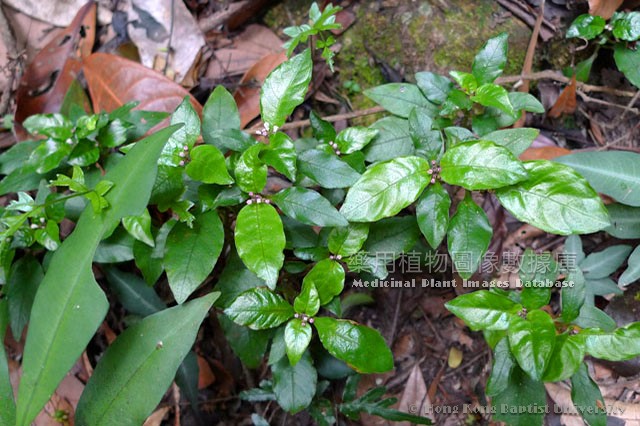
Perennial erect herbs, up to 40cm tall, whole plant nearly glabrous, often purple green. Stem and leaves red after drying, young branches with edges, old branches cylindrical; rhizomes spread into underground. Leaves opposite, papyraceous or membranaceous, oval or oval-elliptic, 4-10cm long, 1-3cm wide, apex obtuse or gradually obtuse-pointed, base round or broadly cuneate, entire, both sides glabrous or upper part with sparse pubescence, lower veins puberulent, lateral veins 6-8 pairs, weak; petioles 1-2.5cm long, slender, stipules short and small, caduceus. Cymes acrogenous, dichotomous branched, branches short, with 5-10 flowers, peduncles 1-2cm long, pubescent; bractlets hairy, linear, 3-7mm long; flowers 5, with short stalks; calyx tube broadly top-shaped spherical, about 1.5mm long, calyx lobes 5, triangular, unfolded; corolla funnel-shaped, light red, slightly with veins, up to 1.7cm long, lobes unfolded, inner surface puberulent; stamens 5, borne below the throat; stigma of long column flowers and anthers of short column flowers included; floral disc ringed, fleshy; ovary inferior. Capsules rhombic or nearly mitral, up to 3-4mm long, 7-9mm in diameter, upper end nearly 1cm wide, nearly glabrous. Seeds small, elliptic. Flowering in winter, fruiting in spring and summer. |
|
Distribution |
Growing in evergreen and broadleaved forests. Distributed in Henan, Anhui, Zhejiang, Fujian, Taiwan, Jiangxi, Hubei, Hunan, Guangdong, Hong Kong, Guangxi, Yunnan, Guizhou, Sichuan, South Gansu and South Shaanxi. The medicinal materials are mainly produced in the central and southern parts of China. |
|
Part Used |
Medical part: entire plant. Chinese name: Shegencao. |
|
Harvest & Processing |
Collected in summer and autumn, sun-dried or used fresh. |
|
Chemistry |
Contains lyalosidic acid, lyaloside, loturine and ophiorines. |
|
Properties & Actions |
Taste tasteless, neutral in nature.Removing phlegm, checking cough, activating blood and regulating menstruation. |
|
Indications & Usage |
Used for cough, hemoptysis caused by overstrain, bloody stools, female algomenorrhea, irregular menstrual period, pain in the bones and muscles, sprains and bruises.Oral administration: decocting, 15-30g. External application: appropriate amount, fresh herb triturated for application. |
|
Examples |
1. Cough due to consumptive disease: rosae chinensis flos 12-30g. Decoct and swallow.
2. Coughing up blood due to impairment caused by overstrain: Japanese ophiorrhiza, ainsliaea fragrans champ. , lepidogrammitis drymoglossoides Ching 15g each. Decoct in water, infuse with white sugar and swallow, one time a day.
3. Bloody stool: (Japanese ophiorrhiza) whole herb 15g. Decoct in water and swallow. |
|
Permanent URL:https://sys01.lib.hkbu.edu.hk/cmed/mpid/detail.php?herb_id=D01324 |
|
|
|


